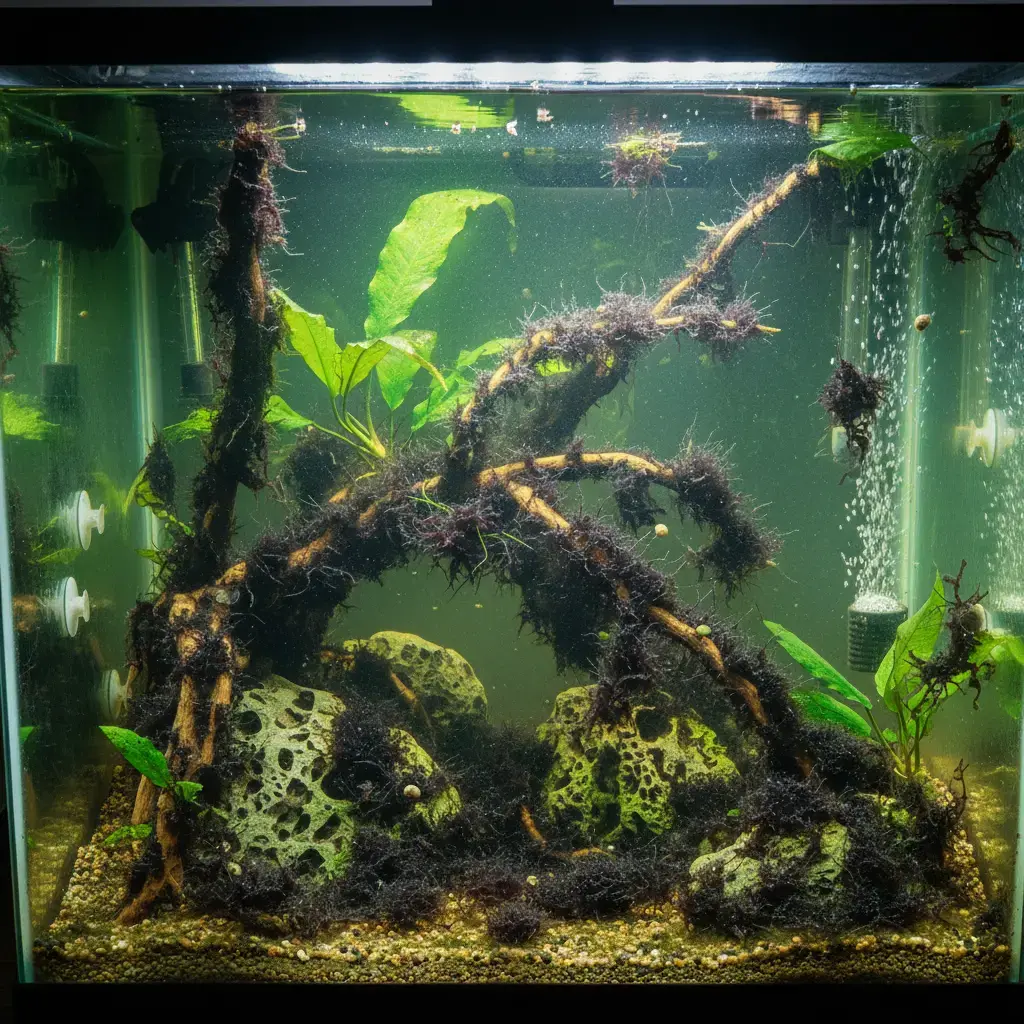
For the modern aquarium enthusiast, maintaining a clean aesthetic is more than just a hobby; it is a pursuit of biological balance. Yet, even the most meticulous hobbyists eventually encounter the most persistent of foes: Black Beard Algae (BBA). Often appearing as dark, fuzzy tufts on driftwood, equipment, or the edges of slow-growing plants, this particular species can transform a pristine aquascape into a source of frustration.
Known scientifically as Audouinella within the Rhodophyta division of red algae, Black Beard Algae is notoriously difficult to eradicate. However, by understanding the science behind its growth and implementing a structured treatment plan, you can reclaim your tank. This guide provides an in-depth look at identifying, treating, and preventing black brush algae for good.
What is Black Beard Algae? Identifying the Black Fuzz
Before you can implement a treatment strategy, you must be certain of what you are fighting. Many hobbyists misidentify various forms of algae, leading to wasted effort and resources.
Visual Identification: Black Brush Algae vs. Black Hair Algae
The term black brush algae is often used interchangeably with black beard algae. In most freshwater aquariums, they are essentially the same nuisance. BBA typically presents as short, dense, carpet-like tufts. It feels coarse and wiry to the touch. In contrast, black hair algae consists of longer, finer strands that sway in the water current.
If you notice black fuzzy algae or black fluffy algae in your aquarium that seems to have a death-grip on your decor, you are likely dealing with BBA. It often begins as small, dark specks that resemble the tip of a felt pen before maturing into the characteristic beard that gives it its name.
The Taxonomy of BBA: A Red Algae in Disguise
Despite its appearance, BBA is a red algae. This classification is vital for treatment. When BBA begins to die, typically after exposure to hydrogen peroxide or liquid carbon, it loses its dark pigments and reveals a bright pink or red color. This is a primary indicator for hobbyists that their treatment is working.
Scientific studies on the physiology of Audouinella highlight its resilience, noting that its cellular structure allows it to thrive in low-light and low-nutrient conditions where other plants might stall. Its dark color is actually a result of high concentrations of phycoerythrin, a pigment that allows it to photosynthesize in deep water or shaded areas by absorbing blue light.
Why BBA is the Most Feared Algae
BBA is feared not just for its looks but for its physical tenacity. Unlike green hair algae, which can be easily manually removed, BBA anchors itself into the substrate and plant tissue using a specialized holdfast. Pulling it off a delicate leaf often results in tearing the leaf itself. Furthermore, it thrives in high-flow areas, meaning it often colonizes the very equipment meant to keep the tank clean, such as filter outlets and CO2 diffusers.
Root Causes: Why is Black Beard Algae Growing in My Fish Tank?
To achieve a long-term solution, you must address the bba algae causes. Algae is rarely a problem of too much of something; it is usually a problem of an imbalance.
The Carbon Dioxide Connection: Liebig’s Law of the Minimum
The most frequent trigger for BBA in a planted tank is fluctuating or insufficient carbon dioxide (CO2). Plants require a stable source of carbon to photosynthesize. This follows Liebig’s Law of the Minimum, which states that growth is dictated not by total resources available, but by the scarcest resource.
In many tanks, carbon is that scarcest resource. When CO2 levels are unstable, which is common in tanks with poorly timed regulators or inconsistent liquid carbon dosing, plants struggle to adapt their internal enzymes. During these periods of plant stress, BBA finds a window of opportunity. Research indicates that dissolved inorganic carbon levels significantly impact the competitive balance between aquatic plants and opportunistic algae.
Nutrient Imbalances and Organic Waste
While many believe that high nitrates cause algae, the reality is more complex. Black brush algae causes are more closely linked to high levels of dissolved organic matter (DOM) and phosphates. When fish waste and uneaten food accumulate, they break down into organic compounds that BBA utilizes. Recent environmental research from organizations like Ohio Sea Grant demonstrates how dissolved organic matter can stimulate harmful algal blooms in freshwater ecosystems, a principle that applies directly to the closed environment of an aquarium.
Flow Dynamics and Detritus
It is no coincidence that BBA is often found on filter pipes. High water flow delivers a constant stream of nutrients and spores directly to the algae. If that flow is also carrying fine particles of detritus due to a dirty filter, you are effectively feeding the BBA. Maintaining a clean aesthetic requires high flow for oxygenation but also high-quality mechanical filtration to ensure that flow is free of organic pollutants.
The Role of Phosphates and Old Tank Syndrome
While the hobbyist community often debates the impact of Nitrates, modern research into limnology and freshwater ecology suggests that Phosphates are a much more significant driver for red algae. In many home aquariums, we suffer from Old Tank Syndrome, where organic phosphates build up in the substrate over years. This creates a luxury uptake scenario where BBA can store nutrients within its cells, allowing it to survive even when you strip the water column of nutrients.
Biological Solutions: The Best Black Beard Algae Eaters
Nature provides its own set of checks and balances. While biological controls should not be your only line of defense, they are invaluable for maintenance.
The Siamese Algae Eater: The Gold Standard
The Crossocheilus oblongus, or Siamese Algae Eater (SAE), is widely considered the best black beard algae eater. They possess unique mouthparts designed to scrape the tough filaments of red algae. According to FishBase data on Crossocheilus oblongus, these fish are native to fast-flowing rivers in Southeast Asia, where they naturally graze on periphyton and various algae species.
Hobbyists must be wary of false Siamese algae eaters. A true SAE has a black stripe that extends all the way through the tail fin and has a slightly serrated edge. Crucially, they should be kept in small groups to reduce stress and increase their grazing activity.
Invertebrate Allies: Amano Shrimp and Nerite Snails
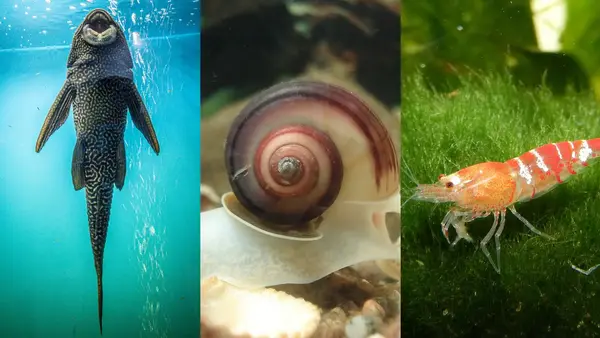
Amano shrimp are the workhorses of the planted tank. While they may not devour a massive tuft of mature BBA, they are excellent at eating the young, soft spores. For black algae on aquarium glass, Nerite snails are unparalleled. They will not damage plants and are effectively the janitors of the hardscape.
Hobbyists often buy two or three Amano shrimp and wonder why the black hair like algae in aquarium persists. In the wild, these shrimp live in massive colonies. For effective BBA control, you should aim for one shrimp per 2-3 gallons of water. Research from The Journal of Crustacean Biology indicates that their grazing efficiency increases significantly when they feel secure in larger groups.
Other Black Algae Fish: Flagfish and Mollies
In larger setups, the Florida Flagfish and certain species of Mollies are known to peck at black hair like algae in aquarium environments. These fish are opportunistic feeders; if they are underfed, they are much more likely to turn their attention to the BBA. However, always research the specific temperature and pH requirements of these fish, as they often differ from the soft-water environments where BBA typically thrives.
Chemical Warfare: Hydrogen Peroxide and Liquid Carbon Treatments
When an infestation becomes unmanageable, chemical intervention is often necessary to reset the balance.
Using Hydrogen Peroxide for Black Beard Algae
Hydrogen peroxide (H2O2) is a powerful oxidizer that can be used safely if handled with care. Scientific research published in PubMed Central (PMC) explores the efficacy of H2O2 as a mitigation strategy for algal blooms, noting its ability to break down quickly into water and oxygen without leaving harmful residues.
For aquarium use, 3% H2O2 is the standard. The most effective method is spot dosing:
- Turn off all filters and powerheads to stop water movement.
- Use a syringe to apply the peroxide directly onto the BBA. Limit your dose to 3ml per gallon of tank water to avoid harming fish.
- Wait 15–20 minutes before turning the equipment back on.
The algae will usually turn pink or white within 24–48 hours, indicating cellular death.
The One-Two Punch: Peroxide and Glutaraldehyde
The "One-Two Punch" is a method popularized by the aquascaping community. It involves a large water change, followed by a dose of hydrogen peroxide to weaken the algae, and then a follow-up dose of a glutaraldehyde-based product like Seachem Flourish Excel. This combination attacks the algae’s cell wall and its ability to process nutrients simultaneously.
Step-by-Step "One-Two Punch"
To maximize the effectiveness of hydrogen peroxide for black beard algae, follow this precise 48-hour protocol:
- Pre-Treatment (Hour 0): Perform a 50% water change. This reduces the organic load and ensures the peroxide reacts with the algae, not the floating waste.
- The Peroxide Hit (Hour 1): With filters off, spot-treat the most infested areas. Use a syringe to cloud the BBA in 3% H2O2. You will see pearling, this is the oxygen being released as the peroxide oxidizes the algae’s cell walls.
- The Carbon Saturation (Hour 24): 24 hours later, dose a triple-strength amount of Seachem Flourish Excel or a similar glutaraldehyde product. This enters the weakened cell walls of the BBA and prevents it from photosynthesizing.
- The Cleanup (Hour 48): At this stage, the black beard algae on plants should be turning a pale pink or white. This is the signal for your black algae fish and shrimp to move in. They rarely eat healthy BBA, but they will devour dead or dying BBA.
Safety Warning for Sensitive Flora: Be cautious when using this method around primitive plants like Liverworts (Riccia), Mosses, or Vallisneria. These plants have thin cell walls similar to algae and can be melted by aggressive chemical treatments.
API AlgaeFix for Black Beard Algae
API AlgaeFix is another option for those looking for a commercial solution. While effective against many types of beard algae, it must be used with extreme caution. AlgaeFix contains surfactants that can interfere with the gill function of shrimp and snails. If you have a clean aesthetic tank featuring ornamental shrimp, avoid this product in favor of more targeted spot-treatments.
Restoring the Aesthetic: Cleaning BBA from Driftwood, Rocks, and Glass
Removing the dead algae is just as important as killing it. Decaying BBA can release nutrients back into the water, fueling the next generation of spores.
How to Remove Black Beard Algae from Driftwood
If you have black beard algae on driftwood, the easiest way to clean it is to remove the piece from the tank. You can use a stiff brush to scrub the wood, or for extreme cases, a diluted bleach dip (1 part bleach to 19 parts water).
According to CDC guidelines on sterilization, a 5-minute contact time with bleach is sufficient to kill most biological organisms. After the dip, rinse the wood thoroughly and soak it in a bucket of water with a 5x dose of dechlorinator to ensure no residual chlorine enters your tank.
Treating Black Beard Algae on Plants
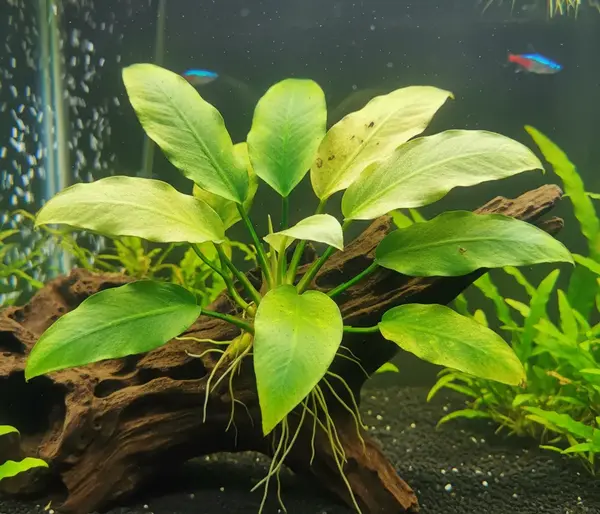
Slow-growing plants like Anubias and Java Fern are BBA magnets. To treat black beard algae on plants, you can perform a localized peroxide bath. Dip the leaves avoiding the roots, into a 50/50 mix of aquarium water and 3% H2O2 for no more than 30 seconds. This is often enough to kill the algae without melting the plant’s leaves.
Maintenance of Aquarium Glass
For black algae on aquarium glass, a simple razor blade or a dedicated scraper is your best tool. To prevent the spread of spores, try to siphon the water near the scraper as you work. This ensures that the dislodged black fuzz algae is removed from the system immediately rather than settling back into the substrate.
Long-Term Prevention: Maintaining a BBA-Free Environment
Achieving the No.1 spot in aquarium health means preventing problems before they start.
Stabilizing Your Ecosystem: The Role of Gas Exchange
Consistency is the enemy of BBA. If you use a CO2 system, ensure your bubble rate is stable. Many hobbyists make the mistake of having high CO2 but low surface agitation. This leads to a build-up of CO2 but a lack of oxygen (O2).
Research into aquatic gas exchange shows that high O2 levels actually help plants process nutrients more efficiently. By increasing surface agitation with a lily pipe or air stone at night, you create a more stable environment that discourages black brush algae while keeping your fish healthy.
Understanding the 4dKH Solution: To prevent bba in aquarium setups, you must master the Drop Checker. A drop checker doesn't actually measure the CO2 in your tank water; it measures the CO2 that has "off-gassed" into the air bubble inside the glass bulb. For the most accurate reading, you must use a "4dKH Reference Solution." If you use tank water inside your drop checker, your readings will be skewed by the tannins and minerals in the water, leading to a false sense of security while BBA continues to thrive.
Filtration and Flow Optimization
Clean your filter media regularly in old tank water. Clogged filters are a major source of the organic waste that drives black brush algae causes. Additionally, ensure your water flow reaches every corner of the tank. Dead spots allow detritus to accumulate, providing a localized nutrient source for black fluffy algae in aquarium setups.
Quarantining New Arrivals
Never introduce a plant that shows even a single speck of BBA. A quick preventive dip for new plants, whether using alum, potassium permanganate, or a weak bleach solution, can save you months of trouble. Remember, green beard algae and black varieties often hitchhike on new purchases from local fish stores.
Troubleshooting: Why the Black Algae Keeps Coming Back
If you have treated your tank but the BBA returns, it is time to look deeper into your routine.
The Canary in the Coal Mine
BBA is often referred to as the "canary in the coal mine" for aquarium health. Its presence usually indicates that the tank's biological filtration is being overwhelmed by organic load. If you see black algae in my aquarium despite perfect nitrate readings, check the substrate. A dirty substrate trapped under a carpet of plants can leach organics that bypass the water column but feed the BBA directly at the source.
Managing Expectations and the Algae Life Cycle
Recovery takes time. When you kill BBA, it doesn't disappear instantly; it changes color and slowly breaks down. Your beard algae eating fish will be much more likely to eat the algae once it is dead or dying. Be patient and stick to your maintenance schedule.
Summary Checklist for a Clean Tank
- Stabilize CO2: Use a drop checker to maintain a consistent 30ppm.
- Reduce Organics: Perform weekly 50% water changes and clean mechanical filter media.
- Control Light: Limit the photoperiod to 7-8 hours and ensure the spectrum is not too heavy in the yellow/green range.
- Biological Help: Maintain a healthy population of Amano shrimp.
- Clean Equipment: Keep diffusers clean to ensure CO2 bubbles are as small as possible for better absorption.
By following this comprehensive approach, you aren't just treating a symptom; you are building a healthier, more resilient aquarium. The clean aesthetic you desire is achievable through a combination of scientific understanding and disciplined maintenance.
Frequently Asked Questions About Black Beard Algae
Why is black beard algae growing in my fish tank even though my nitrates are low?
Low nitrates do not guarantee an algae-free environment. BBA is often triggered by fluctuating or low levels of dissolved inorganic carbon (CO2) rather than just nitrogen. Furthermore, BBA is highly efficient at utilizing organic waste. If you have a build-up of detritus in your substrate or filter, the resulting dissolved organic compounds provide a steady food source for black brush algae. According to research on algal growth and nutrient cycling, phosphates and organic load often play a more critical role in red algae blooms than nitrates alone.
What is the best black beard algae eater for a small aquarium?
In smaller setups where a Siamese Algae Eater might grow too large, the Amano Shrimp (Caridina multidentata) is your best ally. While they are more effective at preventing black fuzzy algae by consuming spores, a large group can help pick apart weakened tufts. For glass surfaces, Nerite snails are excellent as they can scrape the holdfast of the algae without damaging the aquarium silicone or plants.
Can I use hydrogen peroxide for black beard algae if I have shrimp?
Yes, but you must be precise. The standard safe dose for a tank with invertebrates is 1.5ml to 3ml of 3% hydrogen peroxide per gallon of water. To ensure safety, always turn off your filter during spot-treatment to prevent the peroxide from being sucked into the filter and damaging your beneficial nitrifying bacteria. Peer-reviewed studies on hydrogen peroxide as a cyanobacteria and algae control suggest that while it is effective, its rapid oxidation can temporarily lower dissolved oxygen levels, so ensure you have plenty of surface agitation after treatment.
Is black algae in a freshwater tank harmful to my fish?
BBA is not inherently toxic to fish. However, its presence is a biological indicator of an ecosystem out of balance. The conditions that favor black brush algae, such as high organic waste or poor water circulation, can lead to secondary issues like bacterial infections or gill irritation in sensitive fish species. If you see black fluffy algae in your aquarium, it is a sign to check your oxygen levels and filter maintenance.
Why does black beard algae on driftwood seem so much harder to kill?
Driftwood is porous, which allows the BBA holdfast to penetrate deep into the wood fibers. This makes it protected from surface-level grazing by fish. To effectively treat black beard algae on driftwood, it is often best to remove the wood and perform a localized treatment with liquid carbon or a diluted bleach solution (1:19 ratio).
What is the difference between green beard algae and black beard algae?
While both belong to the same growth form, green beard algae is typically a chlorophyte (green algae) and is often caused by high light and low nitrates. Black beard algae is a rhodophyte (red algae) and is much more stubborn due to its specialized pigments and structural proteins. Treatment for green varieties is usually simpler, requiring only a reduction in light intensity and an increase in water changes.
How do I identify black hair like algae in an aquarium versus BBA?
The primary difference is length and texture. Black hair algae grows in long, fine threads that can reach several inches and will flow like hair in the current. BBA stays in tight, compact bushes that rarely exceed half an inch in height. If you can easily wrap the algae around a toothbrush, it is hair algae; if you have to scrape it off with a fingernail, it is BBA.
Does API AlgaeFix for black beard algae actually work?
API AlgaeFix can be effective, but it should be used as a last resort. It works by interfering with the algae's ability to photosynthesize. However, many hobbyists report issues when using it with sensitive invertebrates or in soft water. If you choose this route, ensure you are also addressing the bba algae causes, such as CO2 instability, otherwise the algae will simply return once you stop the treatment.
How long does it take for BBA to die after treatment?
After spot-treating with peroxide or liquid carbon, you should see a color change within 24 to 48 hours. The algae will turn a bright pink, then white, and eventually dissolve or be eaten by your black algae fish. If the tufts remain dark grey or black after three days, the treatment was not concentrated enough or the contact time was too short.
Can I prevent black brush algae by using low light?
Simply lowering the light is rarely a permanent solution. BBA is highly adapted to photosynthesize in low-light environments by utilizing the blue-green spectrum. The key is not just lowering the light, but ensuring the light you do provide is balanced by adequate CO2 and nutrients. A light-only approach often causes your aquatic plants to stall, which actually creates more opportunity for BBA to take over.