How to Use This Calculator
Getting a precise calculation takes only a few seconds:
- Select Your Aquarium's Shape: Choose from the visual library of 18 shapes.
- Choose What to Calculate: Use the "Calculate" dropdown to find the Volume or to solve for a specific dimension like Height or Length.
- Enter Your Dimensions: Fill in the known values and select the appropriate units for each field (in, cm, ft, etc.).
- Get Your Instant Result: Your answer appears in the final field in real-time.
Supported Units
For complete flexibility, you can mix and match any of the following units of measurement:
Linear Units (for Length, Width, Height)
- Meters (m)
- Centimeters (cm)
- Millimeters (mm)
- Micrometers (µm)
- Feet (ft)
- Inches (in)
Volume Units (for Water Capacity)
- Milliliters (ml)
- Liters (L) - A standard Metric unit for volume.
- Cubic Centimeters (cm³)
- Cubic Meters (m³) - The base unit for volume in the Metric system.
- US Gallons (gal) - The standard gallon measurement used in the United States.
- Imperial Gallons (gal) - The gallon measurement used in the United Kingdom and other regions.
- Cubic Feet (ft³)
- Cubic Inches (in³)
What's special about this?
How is this different from a standard aquarium calculator?
While it perfectly calculates aquarium volume in gallons and liters (supports US, UK and international units), it's also a complete tank size calculator. It supports far more shapes and can solve for dimensions, not just volume.
Do I need to convert my measurements to inches or centimeters first?
Not at all. Our calculator allows you to use different units for each measurement and will even convert existing values for you if you change the unit. You can even mix-and-match different units. It is designed to work without any manual conversions on your part.
Does this calculator find the actual water volume or the total tank volume?
This is an excellent and critical question. Our tool is designed to give you both in two distinct sections:
- The main "Calculate" section finds the Total Tank Volume, the full capacity of your aquarium if it were filled to the very top. This is the number you need for choosing heaters and filters.
- The "Water Fill" section calculates the Water Volume based on a specific fill height. This is perfect for knowing exactly how many gallons or liters you're adding during a water change or when first setting up your tank. By adjusting the values, you can even offset for displacements by substrate as well.
There is perhaps no shape more iconic in the aquatic hobby than the classic spherical fish bowl. Evoking a deep sense of nostalgia, the simple round glass globe is often the very first introduction many people have to keeping aquatic life. Today, the traditional fishbowl has evolved far beyond its humble beginnings. Modern aquarists have reclaimed the spherical shape, transforming these elegant glass bubbles into breathtaking, heavily planted nano ecosystems, thriving shrimp habitats, and stunning botanical displays that serve as living centerpieces in any room.
However, beneath the beautiful, minimalist aesthetic lies a significant mathematical puzzle. Calculating the exact water volume of a spherical bowl is arguably one of the most difficult challenges in the aquarium hobby.
If you have ever stared at a round glass bowl and tried to guess its true capacity, you already know that the standard length multiplied by width multiplied by height formula is completely useless. A sphere has no straight edges to measure. But in the delicate world of nano aquariums, guessing your water volume is a dangerous risk. In such a small body of water, water parameters can fluctuate wildly in a matter of hours. Every critical decision you make, from choosing a micro heater to dosing liquid fertilizers for your plants, depends entirely on knowing your exact water volume.
At Guidarium, we are dedicated to helping you succeed in every aquatic endeavor, no matter how small or uniquely shaped your tank may be. In this comprehensive guide, we will explore the anatomy of the spherical fish bowl, explain why precise volume calculations are absolutely vital for maintaining a healthy micro ecosystem, guide you through taking accurate measurements of a curved object, and discuss how real world elements like deep substrate drastically impact your true water capacity.
What is a Spherical Fish Bowl?
Before we dive into the complex geometry of calculating water volume, it is important to understand exactly what a spherical fish bowl is and how its role in the aquarium hobby has shifted over the years. Recognizing the physical structure, its ideal modern applications, and the target audience will help you decide if a round fishbowl is the right choice for your next aquatic project.
The Anatomy and Appeal of the Round Fishbowl
A spherical fish bowl, often called a goldfish bowl or a bubble bowl, is a vessel made from a continuous piece of curved glass or acrylic. Its defining characteristic is its globe like shape. The bowl reaches its maximum width precisely in the middle and curves back inward toward the top, culminating in a flat, circular opening. Many modern bowls also feature a slightly flattened base to prevent them from rolling away, while others sit on decorative stands.
The appeal of the bubble bowl is undeniable. Because there are no corners, no silicone seams, and no opaque frames, a spherical bowl offers a flawless 360 degree viewing experience. It provides a minimalist, clean aesthetic that blends seamlessly into modern home decor, allowing the aquatic life inside to take center stage without the distraction of bulky plastic aquarium trims.
Why Aquarists Choose Bubble Bowls
Hobbyists gravitate toward spherical bowls for their incredible versatility in micro aquascaping. The curved glass acts as a magnifying lens, making tiny details, such as the intricate leaves of aquatic mosses or the vibrant colors of freshwater shrimp, pop with stunning clarity.
Furthermore, the shape is highly conducive to the popular Walstad method, a natural approach to fish keeping where densely packed live plants and a deep soil substrate do the heavy lifting of biological filtration. The deep middle section of the bowl provides ample room for plant roots to spread, while the curved walls naturally push plant growth upward toward the light source at the top opening.
Who Should Use a Spherical Fish Bowl?
It is crucial to address the elephant in the room regarding the traditional use of the fishbowl. Despite decades of popular culture depicting goldfish living happily in small round bowls, modern aquarium science has proven this to be an incredibly harmful practice. Goldfish grow massive, produce an enormous bioload, and require high levels of dissolved oxygen that a small bowl simply cannot provide.
Therefore, a spherical fish bowl should never be used for goldfish or highly active schooling fish. Instead, the modern bubble bowl is the ultimate canvas for the nano aquarist. It is the perfect vessel for keeping Neocaridina shrimp, vibrant Ramshorn snails, or creating a lush, plant only aquascape. It is also an excellent choice for maintaining Opae Ula, a species of tiny Hawaiian volcano shrimp that thrive in small, brackish water setups.
Cost Expectations and Availability
One of the most attractive features of a spherical fish bowl is its accessibility. Because they do not require complex silicone joining or heavy structural bracing, round bowls are generally very affordable. They are widely available not just in pet stores, but also in craft stores, home decor shops, and floral supply centers.
Whether you are purchasing a small one gallon desktop bowl or a large, hand blown five gallon glass globe, the initial investment is usually quite low. This makes the spherical bowl an excellent, budget friendly entry point for hobbyists looking to experiment with planted nano tanks or dedicated shrimp breeding.
The Unique Geometry of Spherical Fish Bowls
To understand why calculating the exact volume of your round tank is so difficult, we need to examine the unique geometry of a sphere. A bubble bowl is a highly complex shape that completely defies traditional aquarium mathematics.
Why the Spherical Shape Complicates Volume Calculation
If you own a standard rectangular aquarium, finding the volume is incredibly straightforward. You measure three straight lines, multiply them together, and convert the result into gallons or liters.
A spherical fish bowl throws all of those rules out the window. Because the walls are continuously curving, the depth and width of the tank are constantly changing depending on exactly where you measure it. At the very bottom base, the width is small. As you move up the glass, the width expands dramatically until it reaches its maximum diameter in the center, and then it shrinks back down as it approaches the top opening.
Mathematically speaking, a fishbowl is not a perfect sphere. Because it has an open top and usually a flat bottom, it is calculated geometrically as a spherical cap or a truncated sphere. To find the volume, you have to use complex formulas involving Pi, the total height of the bowl, and the maximum diameter, factoring in the missing top portion of the sphere. For the average hobbyist simply trying to figure out how much water to add during a water change, this level of geometry is frustrating and leaves massive room for error.
The Optical Illusion of Depth vs Actual Water Volume
Adding to the geometric complexity is the intense optical illusion created by the curved glass. When you fill a spherical glass object with water, it acts exactly like a magnifying glass. The water and the curved surface bend the light entering the bowl, drastically magnifying the contents and stretching the visual field.
This magnifying effect makes the interior of the bowl appear much larger and deeper than it actually is. A simple two gallon fishbowl can easily look like it holds three or four gallons of water.
While this visual enlargement makes the bowl a beautiful display piece, it can cause you to drastically overestimate your true water capacity. Relying on your eyes instead of hard mathematical calculations can lead you to believe you have a much larger buffer of water than you actually do, which is a critical mistake in a nano environment where water stability is paramount.
Why Knowing Your Exact Fishbowl Volume is Crucial
You might wonder if it really matters if your bowl calculations are off by half a gallon. In a large fifty gallon tank, being off by a gallon is a minor rounding error. But in a small spherical bowl, half a gallon could represent thirty percent of your total water volume. In the delicate science of nano aquariums, knowing your exact capacity is the only way to maintain a safe, stable ecosystem.
Sizing Your Aquarium Equipment Correctly
Aquarium life support equipment, specifically heaters and sponge filters, are strictly rated by water volume. If your volume math is incorrect, your equipment choices will be wrong, and in a tiny bowl, wrong choices lead to rapid disaster.
Heating a nano bowl is incredibly tricky. You need a micro heater, and the general rule is 3 to 5 watts of heating power per gallon of water. If you overestimate the size of your bowl due to the magnifying illusion of the glass, you might buy a heater that is too powerful. In a two gallon volume of water, an oversized heater can raise the temperature to lethal levels in a matter of minutes if the thermostat malfunctions. Conversely, an undersized heater will fail to keep the water warm, leaving your tropical shrimp or plants vulnerable to dangerous temperature swings.
Filtration relies just as heavily on accurate volume calculations. If you choose to run a small sponge filter or an air stone, you need an air pump rated for your specific volume. Too much airflow in a tiny spherical bowl will create a chaotic whirlpool effect, exhausting your aquatic pets and uprooting your delicate plants.
Precision Dosing for Medications and Water Conditioners
There is absolutely zero margin for error when dosing concentrated chemicals or fertilizers in a micro aquarium. An accurate aquarium volume calculator becomes a vital tool for ensuring the safety of your delicate ecosystem.
For routine maintenance in a planted bowl, you will likely use liquid fertilizers to feed your plants. In a standard aquarium, you might dose a capful of fertilizer. In a spherical bowl, you are dosing in single drops. Overdosing liquid fertilizers in a small volume of water will instantly trigger a massive, uncontrollable algae bloom that will smother your plants and ruin the aesthetic of the bowl.
The danger is even higher when using water conditioners to remove toxic chlorine, or when treating sick shrimp or snails. Medications are highly concentrated. If you assume your bowl holds three gallons, but the true water capacity is only 1.5 gallons, you will administer a highly toxic overdose. Precision is the difference between a thriving bowl and a total ecosystem crash.
Managing Bioload Limits in a Nano Environment
Determining how much life your bowl can safely support depends directly on your water volume and your surface area. Every living thing in the bowl produces waste, which breaks down into toxic ammonia. The beneficial bacteria process this waste, but they have a biological limit. The total amount of waste your bowl can handle is its bioload limit, and it is entirely dependent on how many true gallons of water are available to dilute the toxins.
Because spherical bowls hold such a small volume of water, their bioload limit is inherently very low. Knowing your exact volume ensures you do not add too many shrimp or snails, preventing an ammonia spike that could wipe out the entire bowl overnight.
How to Measure a Spherical Fish Bowl for Accurate Calculations
To get a flawless result from our Guidarium aquarium volume calculator, you must provide the correct inputs. Measuring a sphere is much more difficult than measuring a straight box, but with the right technique, you can capture the exact dimensions needed.
Finding the True Diameter and Height
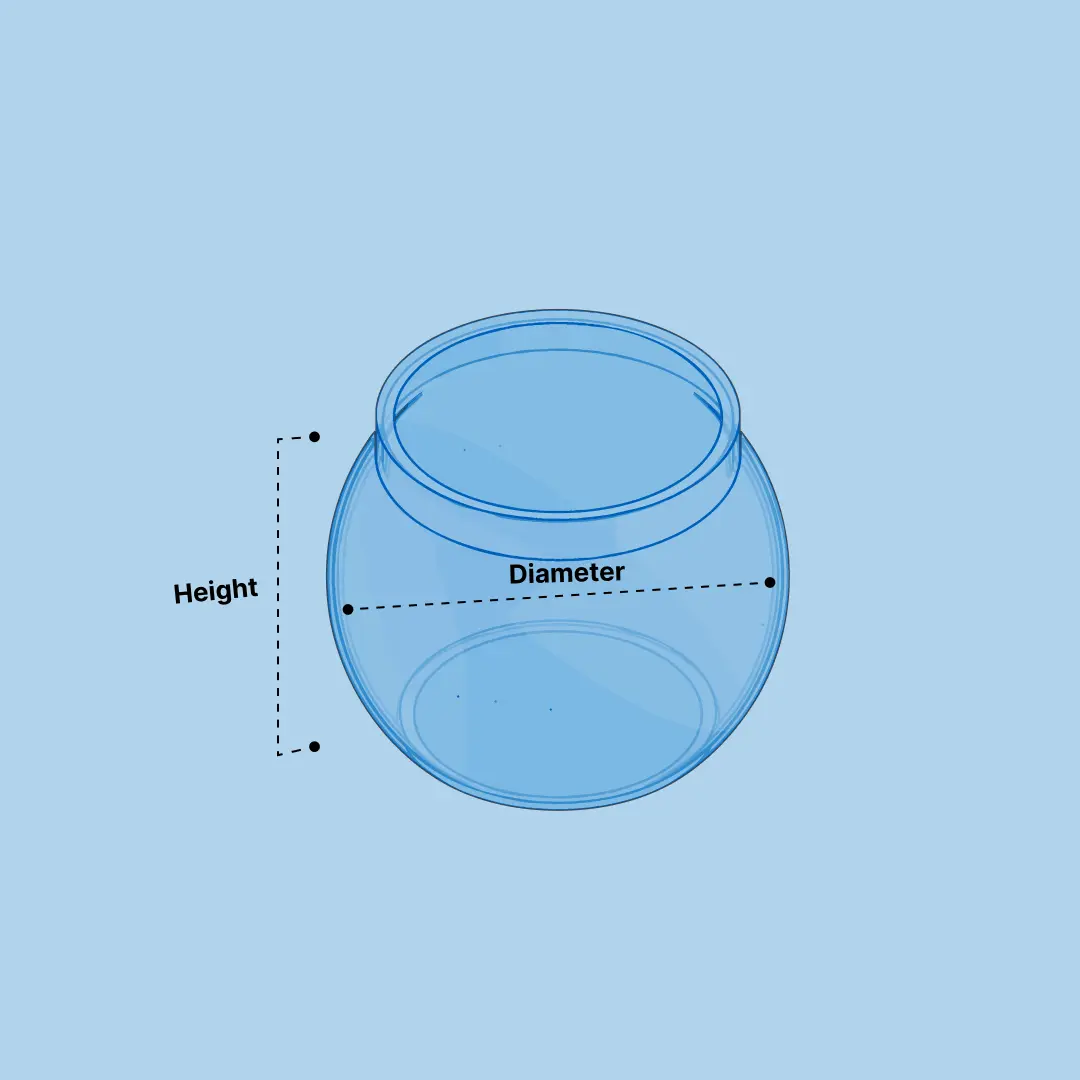
To calculate the properties of a spherical fish bowl, you only need to measure two specific things: the maximum diameter and the total height.
- Diameter: This is the trickiest part of measuring a sphere. You need to find the absolute widest point of the bowl, which is usually right in the middle. You cannot easily wrap a standard tape measure around it to find the diameter. The best method is to place the bowl between two flat, heavy objects like two large books. Push the books until they are touching the widest part of the glass on both sides. Then, remove the bowl and measure the straight distance between the two books. This gives you your exact maximum diameter.
- Height: Measure from the very bottom flat base of the bowl straight up to the top rim of the glass opening.
One of the most powerful features of our specialized calculator logic is its ability to perform reverse calculations using bisection. If you bought a beautiful antique glass globe at a thrift store and you know it holds exactly two gallons of water, but you need to know the diameter to buy a custom lighting halo, the calculator can use the volume and height to reverse engineer the exact widest diameter for you.
The Mathematics Behind the Sphere
Once you have your maximum diameter and total height, the math required involves the formula for the volume of a spherical cap.
First, the calculator divides your maximum diameter in half to find the radius of the imaginary full sphere. Then, it uses a complex formula involving the height of the bowl to calculate the exact volume of the truncated shape. The formula takes the height squared, multiplies it by Pi, divides by three, and then multiplies that by three times the radius minus the height.
Attempting to do this math by hand, while converting cubic inches or centimeters into gallons or liters, is incredibly tedious and leaves a massive margin for human error. Utilizing our specialized calculator ensures that the complex spherical geometry is handled perfectly, down to the last decimal point, every single time.
Inside vs Outside Dimensions: A Common Mistake
A very frequent mistake nano aquarists make when calculating their volume is measuring the outside of the glass.
Spherical bowls, especially hand blown glass or thick acrylic craft store variants, often have surprisingly thick walls to maintain structural integrity.
If you place your tape measure on the outside of the glass, you are calculating the volume of the thick glass walls, not the actual water inside. To find your true maximum water capacity, you must always measure the inside dimensions of the bowl. If the opening is too small to measure the inside diameter accurately, you must subtract the thickness of the glass multiplied by two from your outside diameter measurement before running the math. Neglecting glass thickness in a small nano bowl will artificially inflate your volume calculation significantly.
Real World Capacity: Standard Sizes and Displacement
Even if your measurements are flawless and the complex spherical math is perfectly executed, the final number is still just the gross volume. Gross volume is the absolute maximum amount of water the bowl holds if it is completely empty and filled to the point of overflowing. To find your net volume, which is the actual amount of water your plants and shrimp are living in, we must account for crucial real world factors.
The Truth About Popular Fishbowl Sizes
When shopping for round bowls at retail stores, you will frequently see them sold in standard nominal sizes, such as a 1 gallon, 2 gallon, or 3 gallon bubble bowl.
It is vital to understand that these numbers are rarely exact. Manufacturers prefer clean, whole numbers for retail packaging. A commercially sold two gallon glass bowl might mathematically calculate to 1.7 gallons of gross interior volume.
While a difference of a third of a gallon might seem trivial in a large aquarium, it represents a massive percentage of your total water in a nano setup. Never trust the printed label on the retail box or the sticker on the bottom of the glass. Always take your own internal measurements.
Accounting for Substrate, Rocks, and Driftwood
The concept of water displacement is based on the physical law that any object placed in water will displace an amount of water equal to its own volume. In the micro aquarium world, every handful of soil, every piece of spider wood, and every decorative rock you place in your bowl steals vital water volume.
Spherical bowls experience massive water displacement due to the popular Walstad aquascaping method. To support lush plant growth without a filter, hobbyists usually add a thick, one inch layer of organic potting soil capped with another thick inch of heavy gravel or sand. Because the bottom of the bowl is curved, this deep substrate bed fills a very large portion of the lower spherical cap, displacing a staggering amount of water.
In a standard large aquarium, hardscape might reduce your volume by 10 percent. However, for heavily planted nano bowls with deep substrate beds and intricate centerpieces of driftwood, displacement can easily reduce your water volume by 30 to 40 percent. A beautifully aquascaped two gallon fishbowl might only hold slightly over one gallon of actual, swimmable water.
Leaving Room at the Top: The Fill Line Factor
The final, and arguably most important, element affecting your true spherical tank volume is the fill line. In a standard rectangular tank, leaving an inch of space at the top is standard practice. In a spherical fish bowl, where you place the fill line dictates the entire survival of the ecosystem.
You must never fill a spherical bowl all the way to the top rim. Gas exchange, the critical process where life sustaining oxygen enters the water and toxic carbon dioxide escapes, happens only at the surface of the water. If you fill a sphere to the very top, the surface area shrinks down to the size of the tiny top opening. This completely chokes off oxygen exchange, suffocating everything inside the bowl.
To maintain a healthy environment, a spherical bowl should only be filled slightly past its widest middle point. This ensures you maintain the absolute maximum surface area possible for proper oxygenation. By keeping the water level lower to protect the surface area, you are dramatically reducing the total volume of water in the vessel. When you combine the marketing exaggerations of standard sizes, the massive displacement from deep planted substrate, and the intentionally low fill line required for gas exchange, your large display globe operates with significantly less water than its gross dimensions suggest.
Final Thoughts on Your Spherical Fish Bowl Environment
A perfectly balanced, heavily planted spherical fish bowl is a brilliant way to bring a slice of vibrant nature into your home or office. The sweeping curved glass and magnifying depth make it a truly spectacular piece of living, breathing art that fits perfectly on a desk or countertop. However, guaranteeing the long term health and stability of the delicate micro life living inside requires taking the complex mathematics of the shape incredibly seriously.
By understanding the unique geometry of a truncated sphere, learning how to accurately measure the widest diameter, and recognizing the massive impact of water displacement and crucial surface area fill lines, you elevate your skills as a nano aquarist. Armed with the exact knowledge of your bubble bowl's true capacity, you can confidently purchase the correct micro equipment, safely administer delicate fertilizers, and maintain a pristine, perfectly balanced planted ecosystem for years to come.