How to Use This Calculator
Getting a precise calculation takes only a few seconds:
- Select Your Aquarium's Shape: Choose from the visual library of 18 shapes.
- Choose What to Calculate: Use the "Calculate" dropdown to find the Volume or to solve for a specific dimension like Height or Length.
- Enter Your Dimensions: Fill in the known values and select the appropriate units for each field (in, cm, ft, etc.).
- Get Your Instant Result: Your answer appears in the final field in real-time.
Supported Units
For complete flexibility, you can mix and match any of the following units of measurement:
Linear Units (for Length, Width, Height)
- Meters (m)
- Centimeters (cm)
- Millimeters (mm)
- Micrometers (µm)
- Feet (ft)
- Inches (in)
Volume Units (for Water Capacity)
- Milliliters (ml)
- Liters (L) - A standard Metric unit for volume.
- Cubic Centimeters (cm³)
- Cubic Meters (m³) - The base unit for volume in the Metric system.
- US Gallons (gal) - The standard gallon measurement used in the United States.
- Imperial Gallons (gal) - The gallon measurement used in the United Kingdom and other regions.
- Cubic Feet (ft³)
- Cubic Inches (in³)
What's special about this?
How is this different from a standard aquarium calculator?
While it perfectly calculates aquarium volume in gallons and liters (supports US, UK and international units), it's also a complete tank size calculator. It supports far more shapes and can solve for dimensions, not just volume.
Do I need to convert my measurements to inches or centimeters first?
Not at all. Our calculator allows you to use different units for each measurement and will even convert existing values for you if you change the unit. You can even mix-and-match different units. It is designed to work without any manual conversions on your part.
Does this calculator find the actual water volume or the total tank volume?
This is an excellent and critical question. Our tool is designed to give you both in two distinct sections:
- The main "Calculate" section finds the Total Tank Volume, the full capacity of your aquarium if it were filled to the very top. This is the number you need for choosing heaters and filters.
- The "Water Fill" section calculates the Water Volume based on a specific fill height. This is perfect for knowing exactly how many gallons or liters you're adding during a water change or when first setting up your tank. By adjusting the values, you can even offset for displacements by substrate as well.
There is a specific kind of breathtaking awe that comes from walking entirely around an aquarium. While most fish tanks are pushed against a wall, a double bullnose aquarium is designed to be the absolute center of attention. Featuring a rectangular body seamlessly capped with two beautifully rounded half circle ends, this unique tank shape is the pinnacle of aquatic display. Whether it serves as a stunning room divider in a luxury home, a central island in a public lobby, or a continuous swimming track for active marine species, the double bullnose offers a fully immersive 360 degree viewing experience.
However, designing and maintaining such an architectural masterpiece comes with a highly specific set of challenges. Chief among them is the mathematical headache of calculating its exact water volume.
If you have ever looked at the long, pill like shape of a double bullnose and tried to figure out its true capacity, you quickly realize that standard aquarium math does not apply. You cannot simply multiply the length, width, and height. The addition of two perfectly rounded ends completely alters the total internal space. In the aquarium hobby, guessing your water volume is a risk that can lead to catastrophic consequences. Every foundational decision you make, from sizing your filtration system to dosing life saving medications, relies entirely on knowing exactly how much water is in the system.
At Guidarium, we are dedicated to solving complex aquarium mathematics so you can focus on building your dream aquascape. In this comprehensive guide, we will explore the anatomy of the double bullnose shape, explain why precise volume calculations are critical for fish health, walk you through how to properly measure its unique dimensions, and detail how real world aquascaping choices dramatically impact your final water capacity.
What is a Double Bullnose Aquarium?
Before we explore the complex geometry of calculating water volume, it is important to understand the physical structure of a double bullnose tank and why it is considered a premium shape in the aquarium industry. Recognizing its design mechanics and ideal use cases will help you appreciate the engineering behind your aquatic setup.
The Anatomy and Appeal of the Pill Shape
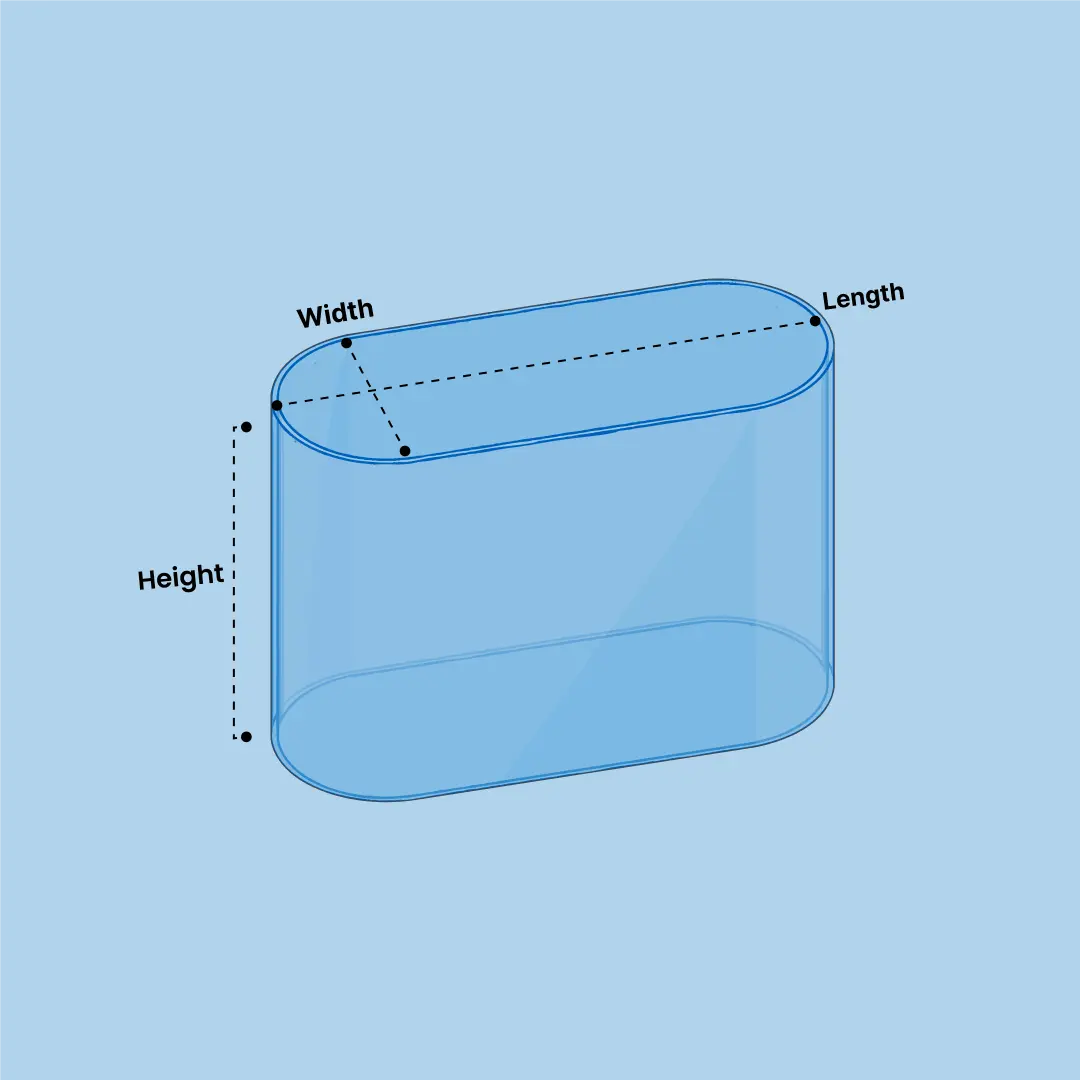
The easiest way to visualize a double bullnose aquarium is to picture a capsule or a pill. The core of the tank is a standard rectangle, providing long, flat viewing panels on the front and back. However, instead of sharp right angles at the left and right sides, the tank features two perfectly smooth, semi circular ends.
This design completely eliminates harsh corners, creating a continuous, flowing perimeter. Because the rounded ends are exactly half circles, the width of the rectangular center is perfectly equal to the diameter of the curved ends. The seamless nature of this design draws the eye along the length of the tank, providing an endless, uninterrupted window into the underwater world from absolutely any angle in the room.
Why Aquarists Choose Double Bullnose Tanks
Hobbyists and professional designers choose the double bullnose shape when they want a tank to act as a central island or a structural room divider. Because there is no dedicated back panel, you can view the aquascape from the living room, walk around the curved end, and view the opposite side from the dining room.
Furthermore, the lack of sharp corners creates incredible opportunities for specialized water flow. In a standard rectangular tank, water crashes into the corners, creating dead spots where detritus accumulates. In a double bullnose, water can circulate in a continuous, uninterrupted gyre. This endless loop mimics the natural currents of rivers and ocean reefs, making it an absolute dream for keeping active schooling fish or delicate corals that require high, smooth water turnover.
Who Should Use a Double Bullnose Aquarium?
This shape is typically reserved for experienced aquarists, professional installers, and high end commercial displays. Because it is meant to be viewed from all sides, setting up a double bullnose requires advanced aquascaping skills. You cannot hide your plumbing, heaters, or filter intake tubes against a black painted back wall. Everything must be carefully hidden within a central overflow box or creatively concealed inside the rockwork.
It is highly recommended for massive island reef tanks, large predator tanks where sharks or rays need continuous swimming lanes without bumping into corners, and fast flowing freshwater river manifold setups.
Cost Expectations and Availability
You will rarely find a double bullnose tank sitting on the shelf at your local pet store. These are almost exclusively custom built aquariums. While they can be made from glass, the complex process of perfectly bending two large glass panels makes them extraordinarily expensive and heavy.
Consequently, most double bullnose aquariums are constructed from thick, high grade acrylic. Acrylic is much easier to mold into seamless, sweeping curves and offers superior clarity. However, custom acrylic fabrication, combined with the need for a specialized custom stand and a floating canopy that matches the exact footprint, means a double bullnose setup requires a very substantial financial investment.
The Unique Geometry of Double Bullnose Aquariums
To understand why calculating your volume is so difficult, we have to look closely at the unique geometry at play. A double bullnose is a hybrid shape that merges the properties of a rectangular prism with the properties of a cylinder, rendering basic aquarium math completely useless.
Why the Rounded Ends Complicate Volume Calculation
If you measure a rectangular tank, you take the length, width, and height, multiply them, and you instantly have your volume.
A double bullnose completely breaks this formula. If you simply measure the maximum length from curve to curve and multiply it by the width and height, you will be calculating the volume of a giant rectangle that encompasses the entire tank. This method includes empty air in the four corners where your tank actually curves inward, leading to a massive overestimation of your water capacity.
To find the true volume, you have to mentally break the tank into three separate pieces. First, you have the central rectangle. Second, you have the left half circle. Third, you have the right half circle. Because two half circles make a complete circle, the mathematical formula requires you to calculate the area of the central rectangle, calculate the area of a full circle based on the width of the tank, add those two areas together to get your total base footprint, and finally multiply that combined area by the height of the water.
The Optical Illusion of Depth vs Actual Water Volume
Adding to the mathematical complexity is the optical illusion created by having both flat and curved viewing panels on the same tank.
When you look through the long, flat sides of the double bullnose, the view is relatively true to size. However, as you walk around to the curved semi circular ends, the tank suddenly acts as a magnifying lens. The water and the curved acrylic bend the light, magnifying the fish and the hardscape.
This creates a visual distortion where the ends of the tank feel vastly deeper and more voluminous than they mathematically are. Relying on this visual depth can trick you into thinking your tank holds a larger buffer of water than it actually does. Trusting the hard geometry rather than your eyes is the only way to accurately understand your tank parameters.
Why Knowing Your Exact Double Bullnose Volume is Crucial
You might wonder if being off by ten or twenty gallons really matters in a large custom aquarium. In the delicate science of water chemistry, precision is everything. Water volume is the core metric for maintaining life support in an aquatic ecosystem. Knowing your exact capacity is the foundation of responsible fish keeping.
Sizing Your Aquarium Equipment Correctly
Because double bullnose tanks are often very long and lack sharp corners, they require specialized equipment setups. Sizing this equipment correctly relies entirely on your volume calculations.
Consider your heating requirements. The standard guideline is to provide 3 to 5 watts of heating power per gallon of total water volume. In a long island tank, a single large heater will often leave the opposite curved end dangerously cold. Aquarists usually split the required wattage into two smaller heaters placed at opposite ends or hidden in the sump. If you overestimate your volume due to the complicated math, you might buy heaters that are far too powerful, risking a malfunction that could boil your tank. If you underestimate, your tropical fish will suffer from cold stress.
Filtration and water flow are equally dependent on accurate math. To achieve the beautiful, continuous gyre flow that the double bullnose shape is famous for, you need water pumps and wavemakers rated for your specific volume. You typically want a flow rate that turns over the entire volume of the tank 5 to 10 times per hour. If you do not know your true capacity, you cannot accurately select the pumps required to keep the water highly oxygenated and free of toxic waste.
Precision Dosing for Medications and Water Conditioners
There is zero margin for error when dosing chemicals or medications in a high value custom aquarium. An accurate aquarium volume calculator becomes an indispensable tool for ensuring the safety of your livestock.
During routine water changes, you must use water conditioners to neutralize chlorine and chloramine. While a slight overdose of standard dechlorinator is usually harmless, the stakes are incredibly high if you run a planted tank and need to dose liquid fertilizers. Dosing too much fertilizer based on an inflated volume calculation will instantly trigger an uncontrollable algae outbreak that can ruin the aesthetic of your 360 degree display.
The danger multiplies when treating fish diseases. Medications for parasites, fungal infections, or bacterial blooms are highly concentrated. They are strictly dosed down to the exact gallon. If you assume your large double bullnose holds 300 gallons, but the true water capacity is only 240 gallons, you could administer a lethal overdose of medication, killing the delicate fish you are trying to save.
Managing Fish Stocking and Bioload Limits
How many fish can you safely keep in your double bullnose? The answer depends directly on your water volume and the biological processing power of your filtration.
Fish produce ammonia, which is highly toxic. The beneficial bacteria in your system consume this ammonia, but they have a limit based on the available surface area and total water dilution. This is known as the bioload limit. Because the curved ends reduce the total physical footprint compared to a standard rectangle of the same maximum length, your double bullnose holds less water than a box of the same dimensions. Knowing your exact, mathematically correct volume ensures you do not overstock the tank, preventing ammonia spikes and keeping your water crystal clear.
How to Measure a Double Bullnose Tank for Accurate Calculations
To get a flawless result from our specialized aquarium volume calculator, you must provide correct and precise inputs. Measuring a double bullnose requires careful attention to the maximum boundaries of the shape.
Finding the True Length, Width, and Height
To calculate the properties of a double bullnose, you need to capture three specific dimensions.
- Length: This is the absolute maximum total length of the aquarium from end to end. You must measure from the furthest protruding point of the left curved glass to the furthest protruding point of the right curved glass. Do not just measure the flat rectangular section. Measure the entire span.
- Width: Measure the distance straight across the flat panels, from the front flat glass to the back flat glass. In a true double bullnose, this total width is exactly equal to the diameter of the semi circular ends.
- Height: Measure from the interior bottom panel straight up to the top rim of the aquarium.
There is a strict geometric rule for this shape. Your width can never be greater than your total length. If your width exceeds your length, the shape is physically impossible to construct as a double bullnose. Our calculator logic strictly enforces this rule to prevent mathematical errors. Furthermore, while our system can brilliantly calculate the required height if you know your desired volume and base dimensions, the unique math of the combined circle and rectangle means you cannot reverse engineer the length or width solely from the volume.
The Mathematics Behind the Base Area
Once you input your measurements, the math required involves isolating the central rectangle from the two ends.
First, the calculator divides your total width in half to find the radius of the curved ends. It then calculates the area of a complete circle using that radius. Next, it subtracts your total width from your total length to find the length of just the flat central rectangle. It calculates the area of that rectangle. It adds the area of the circle and the area of the rectangle together to find your total base footprint. Finally, it multiplies that massive footprint by the height of the tank to determine your gross volume.
Attempting to do this complex breakdown by hand, while converting cubic inches into gallons or liters, practically guarantees a human error. Utilizing our specialized calculator ensures the complex geometry is handled perfectly, instantly, and accurately.
Inside vs Outside Dimensions: A Common Mistake
A critical mistake hobbyists make when calculating volume is placing their tape measure on the outside of the aquarium.
Because double bullnose aquariums are typically large, custom built structures, they are made from incredibly thick acrylic to safely hold the massive weight of the water. It is very common for a large double bullnose to be built with acrylic that is one inch thick or more.
If you measure the outside of the tank, you are calculating the volume of those thick acrylic walls, not the water inside. To find your true maximum water capacity, you must always measure the inside dimensions of the tank. If the tank is already full and sealed with a canopy, you must measure the outside and meticulously subtract the thickness of the acrylic from both sides of the length and both sides of the width before running your calculations. Failing to account for thick acrylic will artificially inflate your calculation by dozens of gallons.
Real World Capacity: Standard Sizes and Displacement
Even with flawless measurements and perfectly executed geometry, the number you generate is still just your gross volume. Gross volume is the maximum amount of water the tank holds if it is completely empty and filled to the absolute brim. An empty plastic box is not an aquarium. To find your net volume, which is the actual water your fish swim in, we must account for real world environmental factors.
The Truth About Custom and Commercial Sizes
Because double bullnose tanks are custom built, they are usually commissioned by an aquarist requesting a specific gallon target, such as a 500 gallon island tank.
It is vital to understand that custom manufacturers often use nominal sizing based on outer dimensions to classify their builds. A tank sold as a 500 gallon double bullnose might mathematically calculate to 470 gallons of actual interior gross volume once the thick acrylic and top bracing are factored in. Never trust the invoice or the label. Always take your own internal measurements to establish your true baseline.
Accounting for Substrate, Rocks, and Driftwood
Water displacement is governed by the Archimedes principle, which dictates that any object placed in water will displace an amount of water equal to its own volume. Every bag of sand, every piece of live rock, and every decorative coral insert you place in your tank directly steals water volume.
Double bullnose aquariums experience massive water displacement due to their 360 degree island aquascaping. Because there is no back wall to lean rocks against, aquarists must build massive, freestanding rock structures directly in the center of the tank, allowing fish to swim in loops around the structure. Building a towering, stable central reef or a massive freshwater mountain requires hundreds of pounds of stone and substrate.
As a general rule, a standard decorative layout reduces gross water volume by 10 percent. However, for a heavily aquascaped island tank packed with dense rockwork, displacement can easily reduce your water volume by 15 to 25 percent. An empty 300 gallon double bullnose might only hold 230 gallons of actual water once the central island is fully built.
Leaving Room at the Top: The Fill Line Factor
The final element affecting your true double bullnose water volume is your fill line. No experienced aquarist fills their tank until the water is touching the very top edge of the rim.
You must leave an air gap at the top of the tank for essential life support functions. Surface agitation is required for oxygen exchange. Your overflow boxes need room to properly skim the surface. Furthermore, leaving a safe gap below the bracing prevents active fish from jumping out of the water and hitting the solid lid.
In a tank with a massive, long footprint like a double bullnose, dropping the water level by just two or three inches removes an astonishing amount of water. When you combine the reality of custom nominal sizing, the massive displacement from central island aquascaping, and the empty space left for the top fill line, your enormous custom display tank operates with significantly less water than you might expect.
Final Thoughts on Your Double Bullnose Environment
A double bullnose aquarium is the ultimate expression of aquatic design. By completely eliminating sharp corners and offering a seamless, flowing perimeter, it transforms a standard fish tank into a captivating, 360 degree living centerpiece. However, guaranteeing the health, safety, and longevity of the delicate ecosystem inside requires taking the complex mathematics of the pill shape seriously.
By understanding the geometry of combining rectangles and circles, learning how to accurately measure your true internal length and width, and recognizing the massive impact of water displacement caused by central island aquascaping, you elevate your skills as a master aquarist. Armed with the exact knowledge of your tank's true capacity, you can confidently size your specialized flow equipment, safely administer precise treatments, and maintain a pristine, perfectly balanced underwater world that dazzles from every angle.