How to Use This Calculator
Getting a precise calculation takes only a few seconds:
- Select Your Aquarium's Shape: Choose from the visual library of 18 shapes.
- Choose What to Calculate: Use the "Calculate" dropdown to find the Volume or to solve for a specific dimension like Height or Length.
- Enter Your Dimensions: Fill in the known values and select the appropriate units for each field (in, cm, ft, etc.).
- Get Your Instant Result: Your answer appears in the final field in real-time.
Supported Units
For complete flexibility, you can mix and match any of the following units of measurement:
Linear Units (for Length, Width, Height)
- Meters (m)
- Centimeters (cm)
- Millimeters (mm)
- Micrometers (µm)
- Feet (ft)
- Inches (in)
Volume Units (for Water Capacity)
- Milliliters (ml)
- Liters (L) - A standard Metric unit for volume.
- Cubic Centimeters (cm³)
- Cubic Meters (m³) - The base unit for volume in the Metric system.
- US Gallons (gal) - The standard gallon measurement used in the United States.
- Imperial Gallons (gal) - The gallon measurement used in the United Kingdom and other regions.
- Cubic Feet (ft³)
- Cubic Inches (in³)
What's special about this?
How is this different from a standard aquarium calculator?
While it perfectly calculates aquarium volume in gallons and liters (supports US, UK and international units), it's also a complete tank size calculator. It supports far more shapes and can solve for dimensions, not just volume.
Do I need to convert my measurements to inches or centimeters first?
Not at all. Our calculator allows you to use different units for each measurement and will even convert existing values for you if you change the unit. You can even mix-and-match different units. It is designed to work without any manual conversions on your part.
Does this calculator find the actual water volume or the total tank volume?
This is an excellent and critical question. Our tool is designed to give you both in two distinct sections:
- The main "Calculate" section finds the Total Tank Volume, the full capacity of your aquarium if it were filled to the very top. This is the number you need for choosing heaters and filters.
- The "Water Fill" section calculates the Water Volume based on a specific fill height. This is perfect for knowing exactly how many gallons or liters you're adding during a water change or when first setting up your tank. By adjusting the values, you can even offset for displacements by substrate as well.
However, the striking geometric design of a corner triangle comes with a significant mathematical hurdle. Figuring out exactly how much water your tank holds is no longer a simple task of measuring a standard rectangular box.
If you have ever looked at the angled front of your wedge shaped tank and wondered what its true capacity is, you are certainly not alone. The standard length multiplied by width multiplied by height formula does not work here. Guessing the volume of your aquarium is a risk you simply cannot afford to take, as every critical decision in the aquarium hobby, from buying the right sized filter to dosing life saving medications, depends entirely on knowing your exact water volume.
At Guidarium, we believe that complex mathematics should never stand in the way of proper fish husbandry. In this comprehensive guide, we will break down the anatomy of the corner triangle shape, explain why precise volume calculations are vital for a healthy ecosystem, guide you through taking accurate measurements of the equal sides and height, and explore how real world elements like heavy rockwork impact your true water capacity.
What is a Corner Triangle Aquarium?
Before we dive into the mathematics of calculating water volume, it is highly beneficial to understand the physical structure of a corner triangle tank and why it holds a unique place in the aquarium hobby. Understanding its design, its ideal use cases, and the expectations associated with it will help you make the best choices for your aquatic setup.
The Anatomy and Appeal of the Wedge Shape
A corner triangle tank is a three sided aquarium built upon an isosceles right angled triangular base. The footprint consists of two perfectly straight glass or acrylic panels of equal length that meet at a sharp 90 degree angle in the back. These two panels are designed to slide flush against the intersecting walls of a room. Connecting these two flat panels is a single, straight diagonal front panel.
This flat front pane is what distinguishes it from a corner cylinder or bowfront. Because the front glass is perfectly straight rather than curved, it provides a distortion free viewing experience from any angle in the room. The sharp geometric lines naturally draw the eye inward toward the deep back corner, making the aquascape feel incredibly dynamic and structured.
Why Aquarists Choose Triangular Corner Tanks
The primary reason hobbyists choose a corner triangle is optimal space efficiency paired with modern aesthetics. Standard rectangular aquariums consume a large amount of flat wall space and protrude awkwardly into the room. A triangular corner tank utilizes the dead space where two walls meet, making it an exceptional choice for smaller rooms, apartments, or busy living areas where floor space is highly valuable.
Beyond practicality, the visual appeal is wonderfully distinct. The straight diagonal front panel creates a clean, modern silhouette that complements contemporary home decor. This shape also lends itself perfectly to forced perspective aquascaping. By building up rocks and driftwood tall in the back 90 degree corner and sloping them down toward the flat front, aquarists can create a stunning three dimensional theater effect that pulls the viewer into the aquatic world.
Who Should Use a Corner Triangle Aquarium?
A corner triangle is an outstanding display tank for those who love geometric design and want to maximize a tight space. It is highly recommended for spectacular community setups, tall planted aquascapes, and showcasing fish that appreciate vertical swimming space and complex hardscape environments.
However, this three sided shape does have some specific limitations. Because the tank tapers down to a sharp 90 degree point in the back, the horizontal swimming distance is drastically shorter than a standard rectangular tank of the same volume. Therefore, a corner triangle might not be the best choice for highly active, schooling fish that require long, uninterrupted horizontal swimming lanes. Furthermore, the sharp back corner can be difficult to clean and often becomes a dead spot for water flow if not properly managed.
Cost Expectations and Availability
Manufacturing a corner triangle aquarium is generally more cost effective than producing a curved corner cylinder, as it only requires cutting and sealing flat panes of glass. However, because it is a specialty shape with unique frame molding requirements, it still typically carries a higher price tag than standard mass produced rectangular aquariums.
Despite being a specialty item, triangular corner tanks are readily available in the hobby. Several manufacturers produce standard wedge sizes, ranging from small desktop nano models to large living room display tanks. When budgeting for a corner triangle, keep in mind that you will also need to purchase a specific triangular stand and a custom shaped lighting fixture or canopy to match the wedge footprint, which will add to your total initial investment.
The Unique Geometry of Corner Triangle Aquariums
To fully grasp why calculating the volume of your triangular tank is so difficult, we need to look at the unique geometry at play. A triangular prism is a shape that completely alters how water occupies the physical space, rendering traditional aquarium multiplication methods totally useless.
Why the Three Sided Shape Complicates Volume Calculation
If you own a standard rectangular tank, finding the volume is incredibly straightforward. You measure the length, width, and height, multiply them together to find the cubic volume, and convert that number into gallons or liters.
A corner triangle aquarium completely breaks those rules. Because the footprint is a triangle, the depth of the tank from the front glass to the back corner is constantly changing depending on where you measure it. At the extreme left and right front edges, the depth is virtually zero. Exactly in the middle of the front glass pane, the distance to the back corner is at its maximum.
You cannot use basic length multiplied by width multiplication because it would calculate the volume of a completely square tank. In reality, a corner triangle is exactly half of a square tank that has been sliced diagonally down the middle. To find the volume, you have to use the mathematical principles of a triangle, calculating the area of the triangular base and then multiplying it by the height. For the average hobbyist simply trying to figure out how much liquid fertilizer to add, this geometric hurdle is frustrating and often leads to serious chemical miscalculations.
The Visual Impact of the Angled Front Panel
Adding to the complexity is the unique visual depth created by the angled front glass. While it does not distort light like a curved bowfront, the diagonal placement pushes the background further away from the viewer in the center while keeping the sides extremely close.
This forced perspective makes the tank appear to hold a massive amount of water in the deep center, but practically zero water at the far left and right edges. A 40 gallon triangular corner tank can easily trick the eye into thinking it holds the same volume as a 55 gallon rectangular tank because the central depth is so profound.
While this deep central cavity makes the corner triangle incredibly beautiful to look at, it can cause you to drastically overestimate the water capacity. Trusting your eyes rather than hard geometric math can lead you to believe you have a much larger buffer of water than you actually possess, setting the stage for overcrowded environments and dangerous ammonia spikes.
Why Knowing Your Exact Corner Triangle Volume is Crucial
You might ask yourself if it really matters if your tank volume math is off by a few gallons. In the delicate science of aquarium keeping, the answer is an absolute yes. Water volume is the core metric for almost every action you take in the hobby. Knowing your exact capacity is the foundation of maintaining a stable, thriving aquatic ecosystem.
Sizing Your Aquarium Equipment Correctly
Aquarium life support equipment, particularly heaters and filters, are strictly rated by water volume. If your volume math is incorrect, your equipment choices will be wrong, too.
Heating a corner triangle effectively requires knowing the exact volume and understanding the shape. The standard guideline is 3 to 5 watts of heating power per gallon of water. If you overestimate the size of your tank, you might buy a heater that is far too strong. An oversized heater will turn on and off rapidly, a process that wears out the internal thermostat and can cause it to stick in the on position, boiling your tank. Conversely, an undersized heater will fail to keep the deep back corner warm enough during cold nights, stressing your fish and leaving them vulnerable to parasitic diseases like Ich.
Filtration relies just as heavily on precise volume calculations. A healthy tank needs a filter with a specific Gallons Per Hour turnover rate. Typically, you want a filter that cycles the entire volume of the tank 4 to 6 times per hour. Triangular tanks are notorious for having severe dead spots in the sharp 90 degree back angle where water flow completely stalls and detritus accumulates rapidly. If you do not know your true volume, you cannot select a filter or circulation pump strong enough to push water completely through that tricky rear corner.
Precision Dosing for Medications and Water Conditioners
There is absolutely zero margin for error when dosing concentrated chemicals or medications in your enclosed aquarium. An accurate aquarium volume calculator becomes a vital life saving tool for ensuring the safety of your fish.
For routine weekly maintenance, you use water conditioners to neutralize toxic chlorine or liquid fertilizers to feed your live aquatic plants. While slightly overdosing a basic dechlorinator is usually harmless, overdosing liquid plant fertilizers can result in massive, uncontrollable green water algae blooms.
The danger is magnified exponentially when treating sick fish. Medications for internal parasites, fungal infections, or severe bacterial diseases are highly concentrated and must be dosed strictly per gallon. If you assume your corner triangle holds 50 gallons, but the true water capacity is only 35 gallons, you could easily administer a lethal overdose of copper based medication. On the other hand, under dosing because you underestimated your volume will render the expensive treatment completely ineffective, allowing the disease to wipe out your entire population.
Managing Fish Stocking and Bioload Limits
Determining exactly how many fish you can safely keep depends directly on your water volume and available surface area. Fish produce biological waste, which naturally breaks down into highly toxic ammonia. The beneficial bacteria living in your filter process this waste, but they have a strict biological limit. The amount of waste your tank can handle is called its bioload limit, and it is entirely dependent on how many gallons of water are available to dilute those toxins.
Corner triangle tanks present a unique stocking challenge. Because they are basically half of a square tank, their surface area is exactly half that of a square tank with the same side lengths. Gas exchange, where vital oxygen enters the water and toxic carbon dioxide escapes, happens only at the top surface. Because a corner triangle has significantly less surface area than people intuitively realize, knowing your exact volume ensures you do not overstock the tank and accidentally suffocate your fish overnight.
How to Measure a Corner Triangle Tank for Accurate Calculations
To get a flawless result from any aquarium volume calculator, you must provide the correct inputs. Measuring a corner triangle is wonderfully simple compared to curved tanks, provided you understand which specific dimensions you actually need to capture.
Finding the True Length and Height
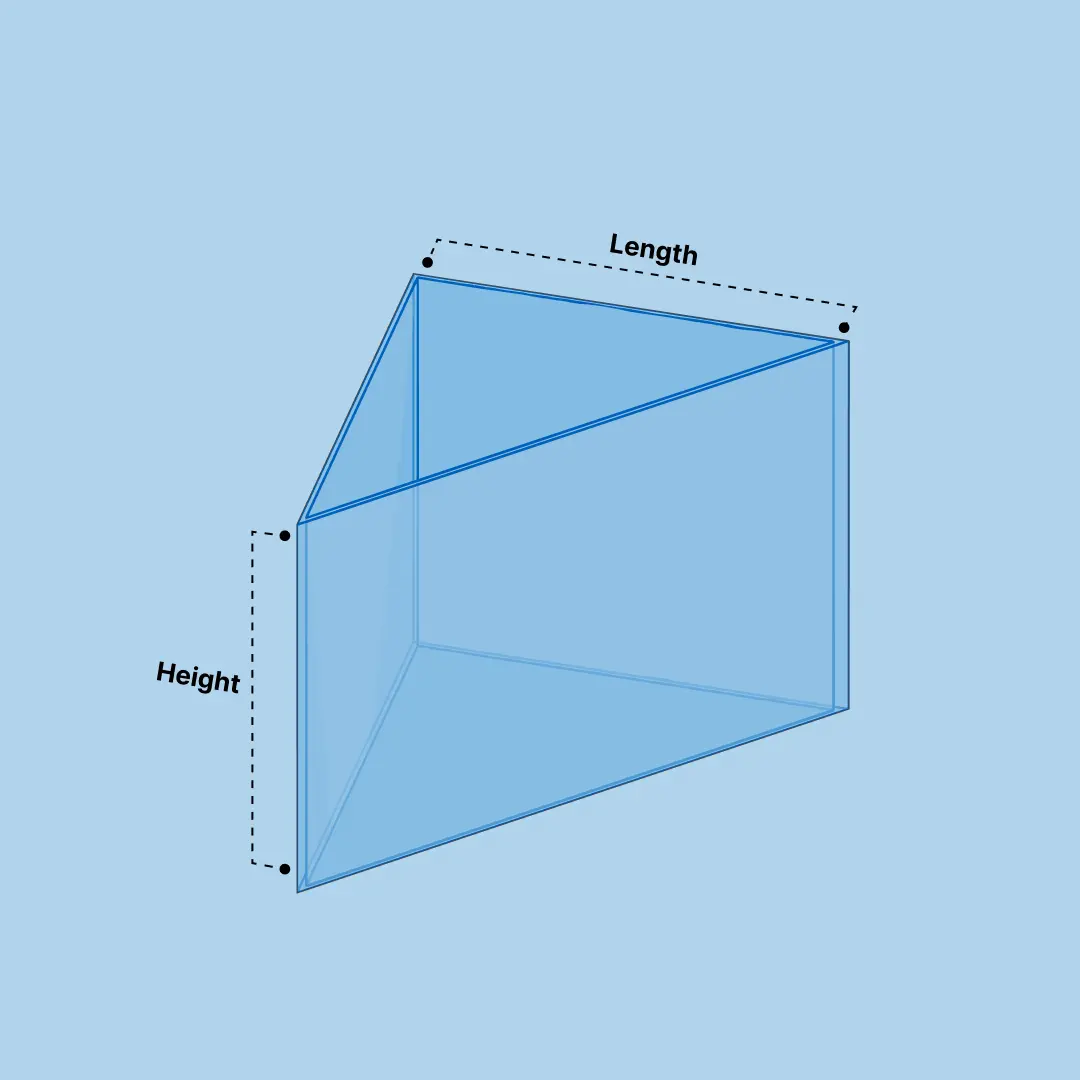
To calculate the properties of a corner triangular prism, you only need to measure two specific things: the length of the wall facing sides and the height of the tank. You do not even need to measure the long diagonal front glass!
- Length: In the context of a corner triangle aquarium, the length refers to the two straight flat panels that sit flush against your room walls. Because the tank is built on an isosceles right angled triangle, both straight back panels should be exactly the same length. You only need to measure one of them. Measure from the sharp 90 degree back corner straight along the glass to the front edge where it meets the diagonal pane.
- Height: Measure from the inside bottom glass panel straight up to the top rim of the aquarium.
One of the incredibly powerful features of our specialized calculator logic is its ability to perform reverse calculations. If you acquired a custom built wedge tank and you know it holds exactly 45 gallons, but you need to build a custom corner stand for it, the calculator can use the known volume and height to reverse engineer the exact wall length for you.
The Mathematics Behind the Triangular Prism
Once you have your straight side length and your height, the math required involves the formula for the volume of a triangular prism.
First, you multiply the length of the straight side by itself (squaring the length). Then, you multiply that number by 0.5 (or divide it by two). This gives you the surface area of your triangular base. Next, you multiply that triangular area by the total height of the aquarium to get your final cubic volume.
Attempting to do this geometric math by hand, while simultaneously converting cubic inches or cubic centimeters into gallons or liters, leaves a massive margin for human error. Utilizing a specialized calculator ensures that the complex geometry is handled perfectly in the background every single time.
Inside vs Outside Dimensions: A Common Mistake
A very frequent mistake aquarists make when calculating their volume is measuring the outside of the aquarium frame.
Glass and acrylic used for triangular tanks can be quite thick to withstand the outward pressure of the water pressing against the long diagonal front pane. Furthermore, these tanks feature thick plastic or custom wood framing along the top and bottom edges.
If you place your tape measure on the outside of the frame, you are calculating the volume of the thick glass panels, the heavy silicone corner seams, and the plastic trim, not the actual water inside the tank. To find your true maximum water capacity, you must always measure the inside dimensions of the tank. If the tank is already full of water and you can only measure the outside, you must subtract the thickness of the glass from your length measurements before doing the math. Neglecting to account for glass thickness will artificially inflate your volume calculation by several phantom gallons.
Real World Capacity: Standard Sizes and Displacement
Even if your measurements are flawless and the geometric math is perfectly executed, the final number your calculator gives you is still just the gross volume. Gross volume is the maximum amount of water the tank holds if it is completely empty and filled to the absolute brim. To find your net volume, which is the actual amount of water your fish are actively swimming in, we must account for real world aquarium factors.
The Truth About Popular Triangular Tank Sizes
When shopping for corner triangle aquariums, you will frequently see them sold in standard nominal sizes. Manufacturers love clean, recognizable numbers for retail packaging.
It is vital to understand that these advertised numbers are often rounded up for marketing purposes. A commercially sold 45 gallon triangular tank might mathematically calculate to 42.5 gallons of gross interior volume when measured accurately. A massive custom 100 gallon wedge might actually hold closer to 95 gallons when measured by the true inner glass boundaries.
While a difference of a few gallons might seem completely trivial, it is the very first deduction in discovering your true water capacity. Never blindly trust the label printed on the retail cardboard box. Always take your own internal measurements.
Accounting for Substrate, Rocks, and Driftwood
The concept of water displacement is based on the Archimedes principle, which states that any object placed in water will displace an amount of water exactly equal to its own volume. In the aquarium world, every bag of decorative sand, every piece of driftwood, and every heavy stone you place in your tank actively steals water volume.
Corner triangle aquariums experience massive water displacement due to how they are typically aquascaped. To make a three sided tank look natural and deep, hobbyists almost always employ a technique called banking. Banking involves piling a massive, towering mound of rocks and heavy substrate into the deep back 90 degree corner, sloping it dramatically downward toward the front diagonal glass. This deep substrate bed and heavy stone structure displaces a staggering amount of water.
As a general rule in the hobby, a standard flat layer of gravel and a few small decorations will reduce your gross water volume by about 10 percent. However, for heavily aquascaped triangular tanks with massive banked stone structures built into the back corner, displacement can easily reduce your water volume by 15 to 25 percent. A heavily decorated 45 gallon corner triangle might genuinely only hold 32 gallons of actual water once the aquascape is finished.
Leaving Room at the Top: The Fill Line Factor
The final element significantly affecting your true triangular tank volume is the top fill line. Aquariums are never filled until the water touches the absolute top edge of the glass. Doing so would cause water to spill over the sides every single time you cleaned the glass with a magnet or reached in to feed the fish.
You must deliberately leave an air gap at the top of the tank for several critical reasons. Hang on back filters need a slight drop for water to cascade and agitate the surface, which is crucial for mandatory oxygen exchange. Equipment cords need physical space to route out the back corner of the canopy. Additionally, many popular fish species are prone to jumping when startled, and leaving a safe two inch gap below the lid prevents tragic accidents.
In a tank with a wedge footprint, dropping the water level by just one or two inches removes a surprising amount of water across the triangular surface area. When you combine the marketing exaggerations of standard sizes, the massive displacement from corner banking aquascaping, and the empty space left at the top fill line, your large corner triangle operates with significantly less water than you might initially assume.
Final Thoughts on Your Corner Triangle Environment
A corner triangle aquarium is a brilliant, space saving way to bring vibrant life, light, and geometric elegance into an otherwise unused corner of your home. The striking diagonal front pane and immersive depth make it a truly spectacular piece of modern living art. However, guaranteeing the long term health, safety, and longevity of the fish living inside requires taking the complex mathematics of the three sided shape very seriously.
By understanding the unique geometry of an isosceles right triangle, learning exactly how to accurately measure your inside wall length and height, and recognizing the massive impact of water displacement caused by heavy corner aquascaping, you elevate yourself from a casual fish keeper to a highly capable aquarist. Armed with the exact knowledge of your triangular tank's true net capacity, you can confidently purchase the correctly sized equipment, safely administer delicate fish medications, and maintain a pristine, perfectly balanced corner display for many years to come.