How to Use This Calculator
Getting a precise calculation takes only a few seconds:
- Select Your Aquarium's Shape: Choose from the visual library of 18 shapes.
- Choose What to Calculate: Use the "Calculate" dropdown to find the Volume or to solve for a specific dimension like Height or Length.
- Enter Your Dimensions: Fill in the known values and select the appropriate units for each field (in, cm, ft, etc.).
- Get Your Instant Result: Your answer appears in the final field in real-time.
Supported Units
For complete flexibility, you can mix and match any of the following units of measurement:
Linear Units (for Length, Width, Height)
- Meters (m)
- Centimeters (cm)
- Millimeters (mm)
- Micrometers (µm)
- Feet (ft)
- Inches (in)
Volume Units (for Water Capacity)
- Milliliters (ml)
- Liters (L) - A standard Metric unit for volume.
- Cubic Centimeters (cm³)
- Cubic Meters (m³) - The base unit for volume in the Metric system.
- US Gallons (gal) - The standard gallon measurement used in the United States.
- Imperial Gallons (gal) - The gallon measurement used in the United Kingdom and other regions.
- Cubic Feet (ft³)
- Cubic Inches (in³)
What's special about this?
How is this different from a standard aquarium calculator?
While it perfectly calculates aquarium volume in gallons and liters (supports US, UK and international units), it's also a complete tank size calculator. It supports far more shapes and can solve for dimensions, not just volume.
Do I need to convert my measurements to inches or centimeters first?
Not at all. Our calculator allows you to use different units for each measurement and will even convert existing values for you if you change the unit. You can even mix-and-match different units. It is designed to work without any manual conversions on your part.
Does this calculator find the actual water volume or the total tank volume?
This is an excellent and critical question. Our tool is designed to give you both in two distinct sections:
- The main "Calculate" section finds the Total Tank Volume, the full capacity of your aquarium if it were filled to the very top. This is the number you need for choosing heaters and filters.
- The "Water Fill" section calculates the Water Volume based on a specific fill height. This is perfect for knowing exactly how many gallons or liters you're adding during a water change or when first setting up your tank. By adjusting the values, you can even offset for displacements by substrate as well.
There is a reason the standard rectangular aquarium is the undisputed king of the fish keeping hobby. Often referred to mathematically as a cuboid, this classic glass box is the foundation upon which almost every aquarist builds their first underwater world. With its straight, clean lines and highly practical footprint, a rectangular tank offers an incredibly versatile canvas for everything from a densely planted aquascape to a thriving community of tropical fish. It is the gold standard shape that has stood the test of time.
However, because the shape is so common and the geometry seems so simple, hobbyists frequently take their water volume for granted. It is incredibly easy to buy a standard 55 gallon tank, set it up, and assume you are working with exactly 55 gallons of water.
Unfortunately, in the aquarium hobby, assuming your water volume based on a retail label is a dangerous game. Even with the straightforward mathematics of a basic rectangle, real world factors drastically alter the true capacity of your tank. Every critical decision you make, from sizing your filtration system and buying the correct heater to dosing highly sensitive fish medications, relies heavily on knowing your exact water volume, not just the number printed on the cardboard box.
At Guidarium, we are dedicated to providing you with the exact tools and knowledge you need to succeed. In this comprehensive guide, we will explore the universal appeal of the rectangular cuboid shape, break down the straightforward math used to calculate its volume, explain why absolute precision is vital for your aquatic ecosystem, and guide you through real world factors like glass thickness and water displacement that impact your true tank capacity.
What is a Rectangular Aquarium?
Before we look at the mathematics of calculating water volume, it is helpful to understand the physical structure of a rectangular tank and why it remains the most popular choice in the aquarium industry. Recognizing its design advantages, its target audience, and its cost benefits will help you understand why this classic cuboid is the ultimate staple of the hobby.
The Anatomy and Appeal of the Cuboid Shape
A rectangular aquarium, or cuboid, is a six sided geometric shape where all faces are rectangles and all intersecting angles are perfectly 90 degrees. In aquarium terms, this means a flat bottom panel, a flat front and back panel, and two flat side panels. There are no sweeping curves, no complex angled corners, and no cylindrical bows.
The primary appeal of this straightforward design is its unmatched practicality. The straight lines provide a clean, traditional look that easily aligns with walls, fits perfectly on standard furniture, and maximizes the use of physical space in a room. Because the viewing panels are perfectly flat, a rectangular tank offers a pristine, distortion free window into your underwater ecosystem from any angle.
Why Aquarists Choose Rectangular Tanks
Hobbyists consistently choose the rectangular shape because it is incredibly easy to work with. The straight edges make cleaning the glass with a magnetic scraper a breeze compared to navigating the curves of a bowfront or corner cylinder.
Furthermore, the entire aquarium industry is built around this specific shape. Almost all life support equipment, including Hang On Back filters, standard canopy lids, mesh screens, and linear LED lighting fixtures, are specifically designed to fit the straight rims of a rectangular tank. You never have to worry about finding custom arched lights or specialized curved lids. The straight lines also make standard rectangular tanks the easiest to plumb for advanced sump systems and reef tank overflows.
Who Should Use a Rectangular Aquarium?
The rectangular tank is universally recommended for everyone, from absolute beginners buying their first starter kit to advanced master aquarists building massive custom reef displays.
It is the absolute best shape for active, schooling fish like tetras, rasboras, and danios, as the long, straight footprint provides maximum uninterrupted horizontal swimming space. Specialized rectangular sizes, like the famous 20 gallon long or the 40 gallon breeder, are highly prized by aquascapers and fish breeders because they offer massive amounts of floor space and surface area relative to their height. Whether you are keeping bottom dwelling corydoras, territorial cichlids, or delicate shrimp, the rectangular footprint is universally accommodating.
Cost Expectations and Availability
Because straight cuts of flat glass and silicone are the easiest to manufacture, rectangular aquariums are by far the most affordable tanks on the market per gallon. You are not paying a premium for specialized kilns required to bend glass or mold acrylic into complex curves.
They are available absolutely everywhere. You can walk into any local fish store or major pet retail chain and find standard rectangular sizes ranging from a tiny 2.5 gallon nano tank up to a massive 125 gallon six foot display. Standard wooden or metal stands are also mass produced for these specific footprints, making the entire setup process significantly cheaper and easier to source than any other aquarium shape.
The Straightforward Geometry of Rectangular Aquariums
When it comes to calculating the volume of your tank, the rectangular cuboid is a breath of fresh air. Unlike the complex pi based mathematics required for cylinders or the fragmented circular segments of a bowfront, the geometry of a rectangle is blissfully simple.
Why the Cuboid is the Gold Standard for Volume Calculation
Finding the gross volume of a rectangular tank relies on the most basic mathematical formula in geometry. You simply measure the length, the width, and the height, and multiply all three numbers together. This gives you the total cubic volume of the space. From there, a simple conversion turns those cubic inches or centimeters into gallons or liters.
Because the depth and width are uniform across the entire tank, there are no changing angles to account for. A rectangular tank that is 12 inches deep on the far left side is exactly 12 inches deep in the dead center and exactly 12 inches deep on the far right side. This uniformity makes it the easiest and most reliable shape to calculate.
The Benefit of Zero Distortion
Because the glass panels are perfectly flat, a rectangular aquarium presents zero optical illusion. In curved tanks, the water and glass act as a magnifying lens, stretching the visual field and making the tank appear much larger and deeper than it truly is.
With a cuboid tank, what you see is exactly what you get. The distance from the front glass to the back glass is visually accurate. This lack of distortion allows aquarists to accurately judge the swimming space available to their fish and makes it much easier to estimate visually how much space a large piece of driftwood or rock is taking up inside the enclosure.
Why Knowing Your Exact Rectangular Tank Volume is Crucial
You might think that because standard rectangular tanks are mass produced in widely known sizes like 10, 20, or 55 gallons, you do not need to bother calculating the volume yourself. However, blindly trusting the nominal retail size is a major mistake. Exact water volume is the foundational metric for keeping your fish alive and healthy.
Sizing Your Aquarium Equipment Correctly
Every piece of equipment you plug into your wall is rated by water volume. If your assumed volume is incorrect, your entire life support system could be compromised.
Heating a rectangular tank requires precision. The general rule is 3 to 5 watts of heating power per gallon of actual water. If you assume your tank holds exactly 55 gallons when it truly only holds 45 gallons of actual water, you will buy a heater that is too powerful. This leads to rapid on and off cycling, which wears out the thermostat and creates a serious risk of overheating the water. Conversely, an undersized heater will struggle to maintain tropical temperatures in a cold room, leading to dangerous temperature fluctuations that cause severe stress and illness in your fish.
Filtration is equally dependent on accurate calculations. A healthy aquarium requires a filter that turns over the entire volume of the tank roughly 4 to 6 times per hour. If you do not know the true volume of your tank, you might select a filter with an inadequate Gallons Per Hour flow rate. In a long rectangular tank, a weak filter will fail to push water all the way to the far corners, creating dead spots where toxic debris accumulates and ammonia levels spike.
Precision Dosing for Medications and Water Conditioners
There is no room for guesswork when you are adding chemicals or medications to a closed ecosystem. An accurate aquarium volume calculator is your most important tool for maintaining water quality and treating disease safely.
Routine water changes require the addition of water conditioners to neutralize chlorine and chloramine. While a small overdose of standard dechlorinator is generally harmless, an overdose of concentrated liquid plant fertilizers can trigger an explosion of algae that chokes out your live plants.
The risk becomes critical when your fish get sick. Medications designed to treat parasites, bacterial infections, or fungal blooms are highly concentrated and dosed strictly by the gallon. If you treat your tank assuming it holds 75 gallons, but massive rockwork and thick glass mean it only holds 60 gallons of water, you will administer a highly toxic overdose of medication. Conversely, under dosing because you underestimated your volume will fail to eradicate the disease, allowing parasites to multiply and potentially wipe out your entire tank.
Managing Fish Stocking and Bioload Limits
How many fish can you safely put in your rectangular tank? The answer lies entirely in your water volume and your surface area. Fish produce organic waste, which naturally breaks down into highly toxic ammonia. The beneficial bacteria living in your filter consume this waste, but they have a strict biological limit. The total amount of waste your tank can safely process is called the bioload limit, and it is entirely dictated by the number of gallons available to dilute the toxins.
Fortunately, standard rectangular tanks offer the best ratio of surface area to water volume, which promotes excellent oxygen exchange at the water surface. However, knowing your exact volume ensures you do not add too many fish. Even with great surface area, overloading the total water volume with too much fish waste will cause the ecosystem to crash.
How to Measure a Rectangular Tank for Accurate Calculations
To get a perfect result from our calculator, you just need a standard tape measure and a few minutes of your time. Because the math relies on three simple dimensions, measuring a rectangular tank is a quick and painless process.
Finding the True Length, Width, and Height
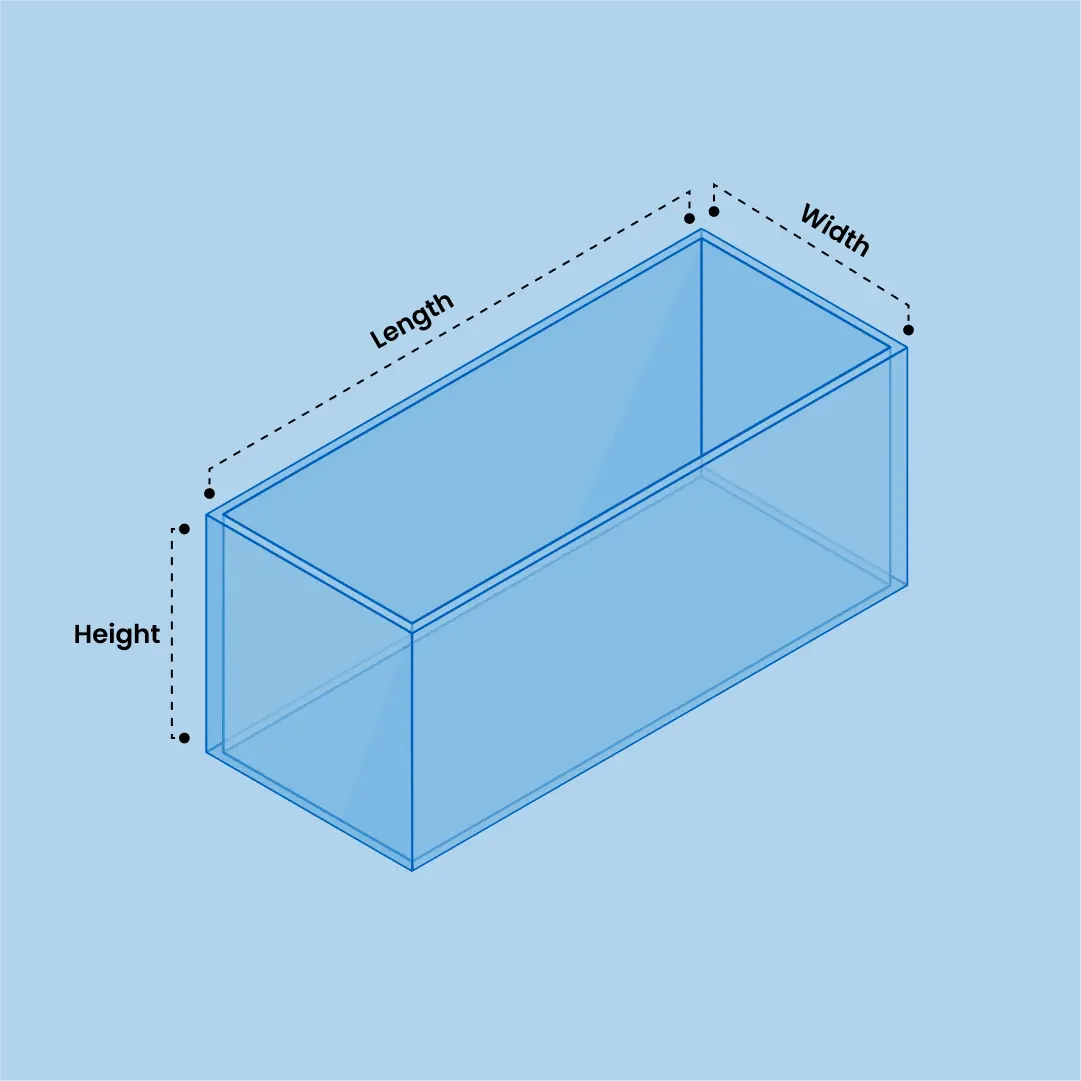
To calculate the properties of a cuboid aquarium, you need to gather three critical measurements.
- Length: Measure the longest side of the aquarium, from the far left edge straight across the front glass to the far right edge.
- Width: Measure the shorter side, from the front glass straight back along the side panel to the back glass. This is also commonly referred to as the depth of the tank.
- Height: Measure from the bottom glass panel straight up to the top rim.
One of the most powerful features of our specialized calculator logic is its ability to perform reverse calculations. Because the math of a cuboid is fully interchangeable, you can find any missing dimension if you know the other three. For example, if you know you want to build a custom 40 gallon tank, and you know you want it to be exactly 36 inches long and 18 inches wide to fit on a specific desk, the calculator will instantly tell you exactly how tall the glass needs to be to achieve that perfect volume.
Inside vs Outside Dimensions: A Common Mistake
The most frequent error hobbyists make when calculating tank capacity is measuring the outside boundaries of the aquarium.
Standard aquariums are constructed with thick glass and held together by bulky plastic framing along the top and bottom edges. Large rectangular tanks, like a 125 gallon display, use very thick glass to prevent the long panels from bowing under the immense water pressure.
If you hook your tape measure on the outside of the plastic frame, you are calculating the volume of the thick glass, the heavy silicone, and the plastic rims, not the water itself. To find your true maximum water capacity, you must always measure the inside dimensions of the tank. If your tank is already set up and full, you must measure the outside and then subtract the thickness of the glass (multiplied by two) from your length and width measurements before entering them into the calculator. Failing to subtract the glass thickness will artificially inflate your final calculation by several gallons.
Real World Capacity: Standard Sizes and Displacement
Even when you perfectly measure the interior dimensions of your tank and run the math, the number you receive is still just the gross volume. This represents the absolute maximum amount of water the tank can hold if it is completely empty and filled to the absolute brim. However, a glass box is not an aquarium. To find your net volume, which is the actual water available to your fish, we have to look at how real world elements subtract from your gross capacity.
The Truth About Popular Rectangular Sizes
When you visit a pet store, you will see rectangular aquariums sold in extremely common nominal sizes. The 10 gallon, 20 gallon high, 20 gallon long, 40 gallon breeder, 55 gallon, and 75 gallon are the undisputed staples of the hobby.
It is crucial to understand that these labels are marketing terms, not exact mathematical guarantees. Manufacturers use clean, recognizable numbers to make selling and buying easier. For example, the famous standard 55 gallon tank usually measures 48 inches long, 13 inches wide, and 21 inches high on the outside. When you account for the interior glass dimensions, the true gross volume often mathematically calculates to roughly 52 or 53 gallons.
A 40 gallon breeder is another classic example. Prized for its massive 36 inch by 18 inch footprint, the actual mathematical volume of this tank often hovers closer to 43 or 44 gross gallons depending on the specific manufacturer. You should never blindly trust the sticker on the front of the tank. Always take your own internal measurements to find the exact starting point for your calculations.
Accounting for Substrate, Rocks, and Driftwood
The Archimedes principle states that any solid object placed in water will displace an amount of water equal to its own volume. In the aquarium hobby, this means that every single thing you put into your rectangular tank steals water volume. This concept is universally known as water displacement.
Aquascaping requires hardscape. If you add two inches of heavy gravel or nutrient rich aquasoil across the entire 48 inch by 13 inch bottom of a 55 gallon tank, you instantly displace a massive amount of water. If you build intricate caves for your cichlids using dense rocks like Texas holey rock or dragon stone, you displace even more. A large piece of waterlogged Malaysian driftwood will further reduce your total capacity.
As a general rule of thumb, a standard layer of substrate and moderate decorations will reduce your gross water volume by 10 to 15 percent. In heavily planted tanks with deep substrate beds and massive hardscapes, displacement can reduce your true water volume by up to 20 percent. Therefore, a fully decorated standard 55 gallon tank might actually only hold 42 to 45 gallons of swimming water for your fish.
Leaving Room at the Top: The Fill Line Factor
The final variable affecting your true rectangular tank volume is the fill line at the top. No responsible aquarist fills their tank until the water is literally touching the top plastic rim. Doing so would guarantee water spilling out onto your floor every time you put your hand in to clean the glass or every time a large fish splashed at the surface.
You must maintain an air gap at the top of the tank. Hang On Back filters require a slight water drop to agitate the surface and promote crucial oxygen exchange. Power cords for your heater and internal circulation pumps need space to route cleanly out the back. Furthermore, many popular rectangular tank inhabitants, like hatchetfish or nerite snails, require a safety buffer to prevent them from jumping or climbing out.
In a long rectangular tank with a massive surface area, dropping the water level by just one or two inches removes a surprising amount of water. When you subtract the marketing exaggerations of nominal sizing, the heavy displacement from your substrate and rocks, and the empty air gap left at the top fill line, your standard 55 gallon rectangular tank is operating with significantly less water than the retail label implies.
Final Thoughts on Your Rectangular Environment
The rectangular cuboid is the ultimate classic for a reason. It is beautiful, practical, affordable, and incredibly versatile. It provides the absolute best footprint for maximizing swimming space and surface area, making it the perfect home for almost any aquatic species. However, ensuring the long term health and stability of the animals inside requires you to treat the mathematics of the hobby with respect.
By understanding the simple geometry of a cuboid, learning how to accurately measure your interior length, width, and height, and recognizing the significant impact of water displacement caused by your aquascape, you take full control of your aquatic environment. Armed with the exact knowledge of your tank's true capacity, you can confidently size your filtration systems, administer delicate medications with absolute safety, and maintain a thriving, pristine underwater world for years to come.