How to Use This Calculator
Getting a precise calculation takes only a few seconds:
- Select Your Aquarium's Shape: Choose from the visual library of 18 shapes.
- Choose What to Calculate: Use the "Calculate" dropdown to find the Volume or to solve for a specific dimension like Height or Length.
- Enter Your Dimensions: Fill in the known values and select the appropriate units for each field (in, cm, ft, etc.).
- Get Your Instant Result: Your answer appears in the final field in real-time.
Supported Units
For complete flexibility, you can mix and match any of the following units of measurement:
Linear Units (for Length, Width, Height)
- Meters (m)
- Centimeters (cm)
- Millimeters (mm)
- Micrometers (µm)
- Feet (ft)
- Inches (in)
Volume Units (for Water Capacity)
- Milliliters (ml)
- Liters (L) - A standard Metric unit for volume.
- Cubic Centimeters (cm³)
- Cubic Meters (m³) - The base unit for volume in the Metric system.
- US Gallons (gal) - The standard gallon measurement used in the United States.
- Imperial Gallons (gal) - The gallon measurement used in the United Kingdom and other regions.
- Cubic Feet (ft³)
- Cubic Inches (in³)
What's special about this?
How is this different from a standard aquarium calculator?
While it perfectly calculates aquarium volume in gallons and liters (supports US, UK and international units), it's also a complete tank size calculator. It supports far more shapes and can solve for dimensions, not just volume.
Do I need to convert my measurements to inches or centimeters first?
Not at all. Our calculator allows you to use different units for each measurement and will even convert existing values for you if you change the unit. You can even mix-and-match different units. It is designed to work without any manual conversions on your part.
Does this calculator find the actual water volume or the total tank volume?
This is an excellent and critical question. Our tool is designed to give you both in two distinct sections:
- The main "Calculate" section finds the Total Tank Volume, the full capacity of your aquarium if it were filled to the very top. This is the number you need for choosing heaters and filters.
- The "Water Fill" section calculates the Water Volume based on a specific fill height. This is perfect for knowing exactly how many gallons or liters you're adding during a water change or when first setting up your tank. By adjusting the values, you can even offset for displacements by substrate as well.
There is something undeniably captivating about a cube aquarium. With its perfect symmetry and modern aesthetic, a cubic tank offers a striking visual departure from traditional long rectangles. Often built with rimless glass and clean silicone seams, the cube has become the gold standard for contemporary aquascaping, nano reefs, and striking centerpiece displays. By offering multiple viewing angles, it allows hobbyists to create breathtaking three dimensional underwater landscapes that look stunning from any side of the room.
However, despite its beautifully simple shape, managing a cube aquarium comes with a hidden set of challenges. While the volume math might seem more straightforward than a curved bowfront, understanding how that volume behaves in a cubic space is entirely different.
If you have ever looked at a perfectly square tank and wondered how its compact footprint affects your true water capacity, you are asking the right questions. The standard length multiplied by width multiplied by height formula works, but only if your tank is a true, flawless cube. Guessing the volume of your aquarium is a risk you do not want to take, as every critical decision in the aquarium hobby, from buying the right sized filter to dosing life saving fish medications, depends entirely on knowing your exact water volume.
At Guidarium, we believe that understanding your tank is the first step to a thriving aquatic ecosystem. In this comprehensive guide, we will break down the anatomy of the cubic shape, explain why precise volume calculations are vital for your equipment and bioload, guide you through taking accurate measurements, and explore how real world elements like central island aquascapes impact your true water capacity.
What is a Cube Aquarium?
Before we dive into the mathematics of calculating water volume, it is helpful to understand the physical structure of a cube tank and why it has exploded in popularity within the aquarium hobby. Understanding its design, its ideal use cases, and the expectations associated with it will help you make the best choices for your setup.
The Anatomy and Appeal of the Cubic Shape
A true cube aquarium features equal, or nearly equal, dimensions across its length, width, and height. The footprint is a perfect square, and the tank rises to a height that matches its base perfectly. This 1 to 1 to 1 ratio creates a sense of profound balance and architectural elegance.
Because of their compact footprint, cube tanks are incredibly versatile. They do not require a long stretch of wall space like a standard rectangular tank. Instead, they can be placed on a sturdy pedestal stand in the corner of an office, at the end of a kitchen counter, or even functioning as a room divider where it can be viewed from three or four different sides. This multi directional viewing is what makes the cube uniquely appealing to modern aquarists.
Why Aquarists Choose Cube Tanks
Hobbyists gravitate toward cubic tanks primarily for their modern aesthetic. Most premium cube tanks on the market are rimless, meaning they lack the bulky black plastic frames found on traditional entry level aquariums. The combination of perfect symmetry, highly polished glass edges, and open tops creates a minimalist piece of living art.
Furthermore, the cube shape revolutionizes aquascaping. Traditional long tanks are typically aquascaped like a diorama, with a clear front, back, and sides. A cube encourages an island aquascape style, where rocks and driftwood are built up directly in the center of the square footprint, allowing fish to swim in a full 360 degree circle around the central structure. This creates an unparalleled sense of depth and natural movement.
Who Should Use a Cube Aquarium?
A cube is the ultimate display tank for specific types of setups. It is heavily favored by saltwater enthusiasts building nano reefs, as the compact shape makes it easy to mount a single, high powered LED light directly over the center to grow coral perfectly. In the freshwater world, cubes are incredibly popular for dedicated shrimp breeding, spectacular betta fish habitats, and densely planted setups featuring single centerpiece fish like angelfish.
However, this shape is not ideal for every species. Because the length is severely restricted compared to a standard rectangular tank of the exact same volume, a cube does not provide long, uninterrupted horizontal swimming lanes. Therefore, a cube is not the best choice for highly active schooling fish, like zebra danios or large rainbowfish, which need long distances to sprint back and forth.
Cost Expectations and Availability
The cost of a cube aquarium varies wildly depending on the construction style. Mass market framed cubes, often sold as all in one kits with a built in filter compartment in the back, are relatively affordable and widely available at local pet stores.
On the other hand, premium rimless cubes are manufactured using specialized ultra clear low iron glass and flawless structural silicone. Because they lack a reinforcing frame, the glass itself must be much thicker to withstand the water pressure. This premium construction means high end rimless cubes carry a significantly higher price tag than a standard glass rectangle of the same gallon capacity.
The Unique Geometry of Cube Aquariums
To fully grasp the dynamics of your cube tank, we need to look at the unique geometry at play. While the shape itself is simple, a perfect square fundamentally changes how water occupies the physical space, which impacts the biology of your entire ecosystem.
The Simplicity and Deception of Cubic Math
If you own a standard rectangular tank, finding the volume requires three distinct measurements. For a flawless cube, the math is refreshingly simple. Because all sides are equal, you only need to measure one single side. You take that length and multiply it by itself three times (length cubed).
However, this simplicity can be deceptive. A 27 gallon cube tank holds roughly the same amount of water as a 29 gallon standard rectangular tank. But the way that water is distributed is entirely different. The 29 gallon rectangle spreads the water out over a long distance, while the 27 gallon cube stacks the water up high in a compact square. This geometric difference drastically alters the surface area to volume ratio, which is a critical factor in oxygenating your water.
The Optical Illusion of Depth vs Actual Water Volume
Just like curved glass tanks, perfect cubes create their own visual illusions. Because the front to back depth is identical to the side to side length, a cube offers an incredible amount of front to back real estate.
When you build a steep aquascape that slopes from the top rear corner down to the bottom front glass, the forced perspective makes the tank look impossibly deep and voluminous. A well scaped 60 gallon cube can easily look like a massive 100 gallon system because the square footprint tricks the human eye, which is used to seeing shallow rectangular aquariums.
While this visual depth is the primary reason we love cubic tanks, it can cause you to drastically overestimate the swimming space and water capacity. Relying on your eyes rather than hard mathematics can lead to poor stocking choices and overcrowded environments.
Why Knowing Your Exact Cube Volume is Crucial
You might ask yourself if it really matters if your tank calculations are slightly off. In the delicate science of aquarium keeping, the answer is an absolute yes. Water volume is the core metric for almost everything you do in the hobby. Knowing your exact cubic capacity is the foundation of maintaining a stable, healthy aquatic ecosystem.
Sizing Your Aquarium Equipment Correctly
Aquarium life support equipment, particularly heaters and filters, are strictly rated by water volume. If your volume math is incorrect, your equipment choices will be entirely wrong.
Heating a cube effectively requires knowing the exact volume. The standard guideline is 3 to 5 watts of heating power per gallon of water. If you overestimate the size of your tank, you might buy a heater that is far too strong, risking a malfunction that could dangerously overheat your water. Conversely, an undersized heater will fail to keep the water warm enough, leaving your tropical fish vulnerable to stress and disease.
Filtration and water flow are especially tricky in a cube. Because the footprint is a square, standard filters often struggle to push water all the way down to the bottom front corners, creating dead spots where toxic debris accumulates. To combat this, cube owners often need specialized wavemakers. If you do not know your true volume, you cannot select a pump with the correct Gallons Per Hour turnover rate to ensure proper circulation throughout that deep square space.
Precision Dosing for Medications and Water Conditioners
There is absolutely zero margin for error when dosing concentrated chemicals or medications in your aquarium. An accurate aquarium volume calculator becomes a vital tool for ensuring the safety of your fish.
For routine maintenance, you use water conditioners to remove toxic chlorine or liquid fertilizers to feed your live plants. While a slight overdose of a basic dechlorinator is generally harmless, overdosing concentrated liquid fertilizers in a small cube can trigger massive, tank crashing algae blooms.
The danger is significantly higher when treating sick fish. Medications for parasites, fungal infections, or bacterial diseases are highly concentrated and must be dosed specifically per gallon. If you assume your cube holds 40 gallons, but the true water capacity is only 30 gallons, you could inadvertently administer a lethal overdose of medication. On the other hand, under dosing because you underestimated your volume will render the treatment completely ineffective.
Managing Fish Stocking and Bioload Limits
Determining how many fish you can safely keep depends directly on your water volume and your available surface area. Fish produce waste, which breaks down into toxic ammonia. The beneficial bacteria in your filter process this waste, but they have a biological limit. The total amount of waste your tank can handle is called its bioload limit, and it is entirely dependent on how many gallons of water are diluting those toxins.
Cube aquariums present a unique bioload challenge. Because a cube is relatively tall and compact, it has a surprisingly small surface area compared to its total volume. Gas exchange, where vital oxygen enters the water and toxic carbon dioxide escapes, happens exclusively at the surface. Because a cube has less surface area than a long tank of the same volume, knowing your exact capacity ensures you do not overstock the tank and accidentally suffocate your fish through oxygen depletion.
How to Measure a Cube Tank for Accurate Calculations
To get a flawless result from any aquarium volume calculator, you must provide the correct inputs. Measuring a cube is arguably the easiest of all tank shapes, provided your tank is a true geometric cube and you account for the thickness of your glass.
Finding the True Length
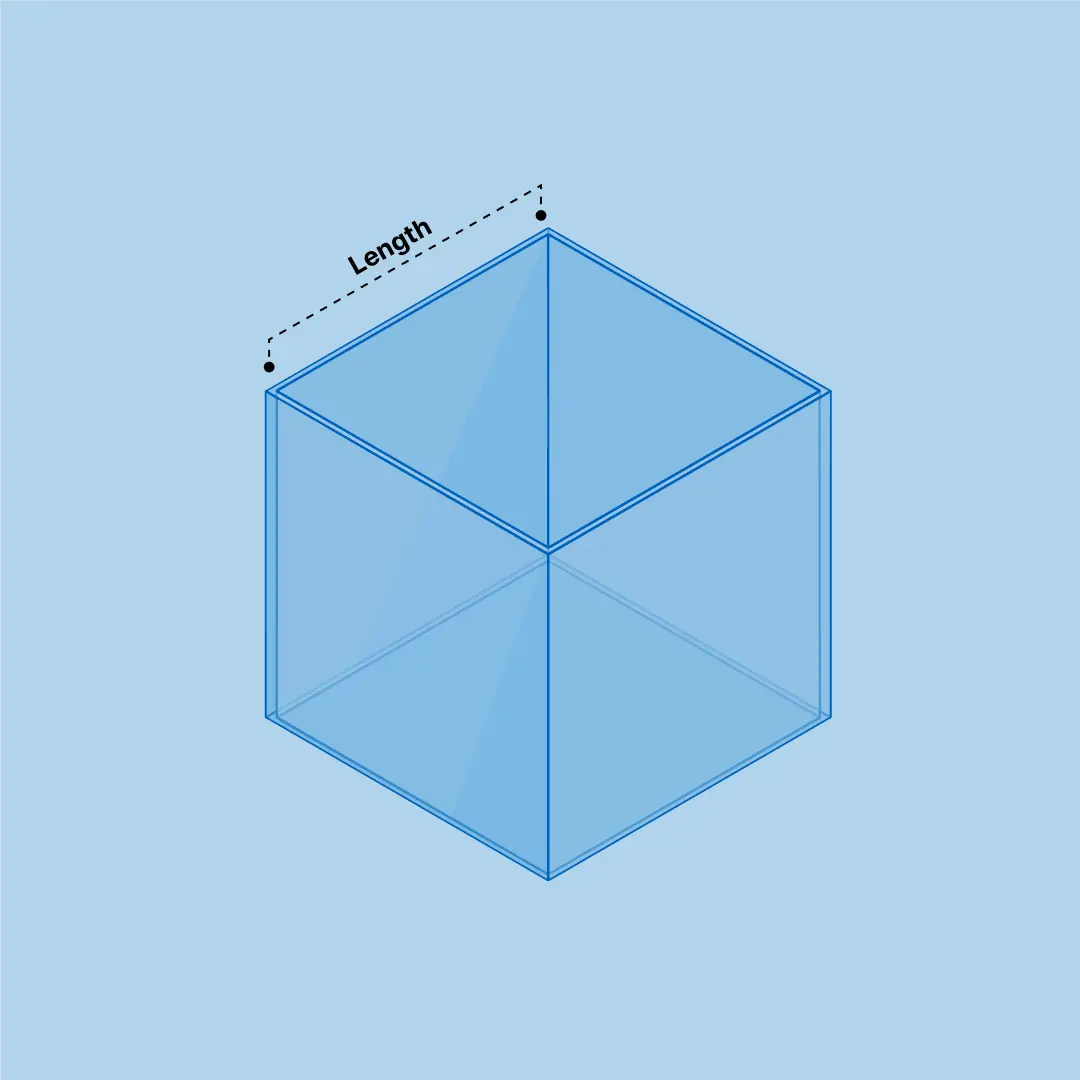
To calculate the properties of a true cube aquarium, you only need to measure one single dimension.
- Length: Pick any flat side of the aquarium. Measure horizontally straight across the glass panel from one edge to the other. Because a cube features equal length, width, and height, this single number is all the mathematical data required.
However, you must be incredibly careful to verify that your tank is actually a perfect cube. Many manufacturers sell tanks labeled as cubes that are actually near cubes. For example, the footprint might be a perfect 18 by 18 inch square, but the tank might be 19 inches tall. If you assume it is a perfect cube and only measure the width, your final volume calculation will be completely incorrect. Always quickly measure the height just to verify the dimensions match exactly before using a true cube calculator.
One of the most powerful features of our specialized calculator logic is its ability to perform reverse calculations using cube roots. If you purchased a used rimless cube and you know it holds exactly 64 gallons, but you need to build a custom square wooden stand, the calculator can reverse engineer the exact length of the sides for you instantly.
The Mathematics Behind the Cube
Once you have your verified single length measurement, the math required is wonderfully straightforward.
You simply take your length measurement and cube it. This means you multiply the length by the width, and then multiply that result by the height. Since all three numbers are identical, you are just multiplying the length by itself three times.
While the core math is easy, converting cubic inches or cubic centimeters into actual usable liquid gallons or liters leaves a large margin for simple arithmetic errors. Utilizing a specialized calculator ensures that the unit conversions are handled perfectly every single time, giving you peace of mind.
Inside vs Outside Dimensions: A Common Mistake
A very common and highly impactful mistake aquarists make when calculating their volume is measuring the outside of the aquarium glass.
Because premium cube tanks are often rimless, they require exceptionally thick glass to maintain structural integrity without the help of a plastic brace. It is very common for a high end 60 gallon cube to use glass that is nearly half an inch thick on all four sides and the bottom.
If you place your tape measure on the outside of the glass, you are calculating the volume of the thick glass walls themselves, not the actual water contained inside them. To find your true maximum water capacity, you must always measure the inside dimensions of the tank. If the tank is currently full of water and you can only measure the outside, you must subtract the thickness of the glass (multiplied by two, to account for both sides) from your length measurement before doing the math. Neglecting heavy glass thickness will artificially inflate your volume calculation by several gallons.
Real World Capacity: Standard Sizes and Displacement
Even if your measurements are flawless and the geometric math is perfectly executed, the final number is still just your gross volume. Gross volume is the maximum amount of water the glass box holds if it is completely empty and filled to the absolute point of overflowing. To find your net volume, which is the actual amount of water your fish are actively swimming in, we must account for real world aquarium factors.
The Truth About Popular Cube Sizes
When shopping for cube aquariums, you will frequently see them sold in standard nominal sizes. Popular examples include the famous 14 gallon biocube, the 30 centimeter nano cube, the standard 60 gallon cube, and the massive 93 gallon cube display.
It is vital to understand that these numbers are often rounded up for retail marketing purposes. Manufacturers prefer clean, recognizable numbers. A commercially sold 60 gallon cube might mathematically calculate to 58.5 gallons of gross interior volume.
While a difference of a gallon or two might seem trivial, it is the first major deduction in discovering your true water capacity. Never trust the printed label on the retail cardboard box. Always take your own internal measurements.
Accounting for Substrate, Rocks, and Driftwood
The concept of water displacement is based on the Archimedes principle, which states that any physical object placed in water will displace an amount of water exactly equal to its own volume. In the aquarium world, every bag of active soil, every piece of spider wood, and every decorative dragon stone you place in your tank permanently steals water volume.
Cube aquariums experience significant water displacement due to how they are typically aquascaped. Because they are often viewed from three sides, hobbyists usually build massive central island structures. A towering pile of heavy rockwork built directly in the center of the square footprint displaces a staggering amount of water.
As a general rule in the hobby, a standard layer of gravel and a few small decorations will reduce your gross water volume by roughly 10 percent. However, for heavily aquascaped island tanks with massive stone structures, displacement can easily reduce your water volume by 15 to 20 percent. A heavily decorated 60 gallon cube might only hold 48 gallons of actual, treatable water once the hardscape is finished.
Leaving Room at the Top: The Fill Line Factor
The final element significantly affecting your true cube tank volume is the fill line. Aquariums are never filled until the water touches the absolute top edge of the rimless glass. Doing so would cause water to slosh over the sides every time you cleaned the glass or a fish splashed at the surface.
You must leave an air gap at the top of the tank for several highly practical reasons. Hang on back filters and skimmers need a slight drop for water to agitate the surface. Powerheads create waves that require buffer space. Additionally, many popular cube inhabitants are known jumpers, and leaving a safe gap below the rim or screen lid prevents tragic accidents.
In a tank with a perfectly square footprint, dropping the water level by just one or two inches removes a surprising amount of water volume across that surface area. When you combine the marketing exaggerations of standard retail sizes, the massive displacement from a central island aquascape, and the empty space left at the top fill line, your beautiful cube operates with significantly less water than you might initially assume.
Final Thoughts on Your Cube Environment
A cube aquarium is a brilliant way to bring a piece of modern, living art into any room. The perfect symmetry and the ability to view your underwater world from multiple angles make it a truly spectacular centerpiece. However, guaranteeing the health and longevity of the fish and plants living inside requires treating the mathematics of the shape with strict attention to detail.
By understanding the unique surface area constraints of a square footprint, learning how to accurately measure your inside length while accounting for thick rimless glass, and recognizing the massive impact of water displacement caused by island aquascaping, you elevate yourself to a highly capable aquarist. With the exact knowledge of your tank's true capacity, you can confidently purchase the correct flow equipment, safely administer delicate treatments, and maintain a pristine, perfectly balanced cubic display for years to come.