
Can Peacock Bass Ocellaris and Pearly Ocellatus Live Together?
Peacock Bass Ocellaris and Pearly Ocellatus are not recommended as tank mates due to conflicting pH requirements. Housing these species together is likely to result in stress, health problems, or direct harm to one or both fish.
At a Glance
Can your tank handle Peacock Bass Ocellaris and Pearly Ocellatus?
Compatibility is only part of the answer. Test both fish with your real tank size, current stock, and maintenance needs to see if you have enough space and a safe stocking level before you add them.
Behaviour & Temperament
Both Peacock Bass Ocellaris and Pearly Ocellatus are semi-aggressive species with an aggression score of 7/10. Their matching temperaments mean neither fish is likely to dominate the other in a shared aquarium.
Both Peacock Bass Ocellaris and Pearly Ocellatus are highly aggressive, increasing the risk of violent confrontations.
In terms of spatial distribution, Peacock Bass Ocellaris prefers the Middle (Open Water) and Top (Surface) zones, whereas Pearly Ocellatus occupies the Bottom (Substrate) zone. Because they use different levels of the water column, territorial disputes are less likely and the tank will appear more balanced.
Additional behavioural considerations to keep in mind: Two territorial species may clash over territory, especially in smaller tanks.
Worth noting: Peacock Bass Ocellaris is a known jumper, so a tight-fitting lid is essential.
Water Parameters
The safe temperature window for both species falls between 25°C and 27°C. Aim for the midpoint of this range (around 26.0°C) for optimal comfort.
The pH requirements of Peacock Bass Ocellaris (6.5–7.5) and Pearly Ocellatus (8–9) do not overlap, making it impossible to satisfy both species simultaneously.
For general hardness, the shared comfort zone is 10–15 dGH. Regular testing will ensure conditions stay within this range.
Tank Setup
To house Peacock Bass Ocellaris and Pearly Ocellatus together, plan for an aquarium of at least 1500 litres with a minimum length of 240 cm. This recommendation combines the stricter species minimums with a community-load allowance so the pairing has realistic long-term space and filtration headroom.
Providing a mix of open swimming space and sheltered areas with rocks, driftwood, or plants will keep both species comfortable and allow natural behaviour.
Specific environmental needs for this combination include: Driftwood (Digestion/Hiding), Smooth Gravel (Sensitive Barbels), Sand (Sifters), Shells (Breeding/Hiding). Meeting these requirements will help both species thrive.
Both species do well with moderate (standard) water movement, so a standard filtration setup rated for the tank volume should suffice.
Why This Pairing Usually Fails in Practice
Peacock Bass Ocellaris and Pearly Ocellatus are the kind of pair that can look acceptable in a shop but become a maintenance problem at home. The main risk is not a single number in the chart; it is the way incompatible behavior, water needs, or pressure on space compounds over time once both fish are established in the same tank.
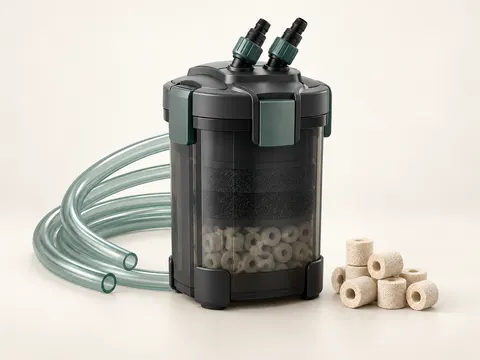
Supplies for Peacock Bass Ocellaris & Pearly Ocellatus
We may earn from qualifying purchases



Frequently Asked Questions
Can Peacock Bass Ocellaris and Pearly Ocellatus live together?
No. This combination is not recommended. Key incompatibilities — such as critical behavioural conflicts — make cohabitation unsafe.
What size tank do Peacock Bass Ocellaris and Pearly Ocellatus need?
A minimum of 1500 litres (tank length at least 240 cm) is recommended. This provides enough space for both species to establish their own areas and reduces the likelihood of territorial disputes.
What water temperature is best for Peacock Bass Ocellaris and Pearly Ocellatus together?
Keep the aquarium between 25°C and 27°C. A target of around 26.0°C sits comfortably within both species' preferred ranges.
Are Peacock Bass Ocellaris or Pearly Ocellatus aggressive?
Peacock Bass Ocellaris is semi-aggressive (7/10) and Pearly Ocellatus is semi-aggressive (7/10). Their similar temperaments generally lead to a peaceful coexistence.
What pH do Peacock Bass Ocellaris and Pearly Ocellatus need?
Their pH requirements do not overlap. Peacock Bass Ocellaris prefers 6.5–7.5, while Pearly Ocellatus needs 8–9. This makes them incompatible in the same water chemistry.
How do I manage Peacock Bass Ocellaris's territorial behaviour?
Provide line-of-sight breaks using rocks, driftwood, and dense planting. A larger tank gives Peacock Bass Ocellaris space to claim a territory without encroaching on the other fish's area. Adding décor that divides the tank into distinct zones works especially well.
Shared setup supplies
We may earn from qualifying purchases




Guidarium Editorial Desk
Reviewed against Guidarium care, stocking, and compatibility standards. Read the editorial policy.
- Last reviewed
- May 7, 2026
- Last updated
- May 7, 2026
- Issues or corrections?
- Contact the editorial team
Related Comparisons
Peacock Bass Ocellaris & Peacock Bass Monoculus
·
Peacock Bass Ocellaris & Peacock Bass Orinocensis
·
Peacock Bass Ocellaris & Aequidens Jenaro Herrera
·
Peacock Bass Ocellaris & Andinoacara sp. Gold Saum
·
Peacock Bass Ocellaris & Bahia Red
·
Peacock Bass Ocellaris & Blue Acara
·
Pearly Ocellatus & Black Ocellatus
·
Pearly Ocellatus & Afra Cichlid
·
Pearly Ocellatus & African Jewel Cichlid
·
Pearly Ocellatus & Altolamprologus Calvus
·
Pearly Ocellatus & Altolamprologus Compressiceps
·
Pearly Ocellatus & Auratus Cichlid (Mbuna)
·