
Can Banded Cichlid and Twig Catfish (Farlowella) Live Together?
Keeping Banded Cichlid and Twig Catfish (Farlowella) together is possible but requires caution, though some care is needed. Provide a spacious tank of at least 250 litres with plenty of hiding spots to reduce stress. Monitor behaviour closely, especially during the first few weeks.
At a Glance
Can your tank handle Banded Cichlid and Twig Catfish (Farlowella)?
Compatibility is only part of the answer. Test both fish with your real tank size, current stock, and maintenance needs to see if you have enough space and a safe stocking level before you add them.
Behaviour & Temperament
Banded Cichlid is a generally mild-mannered species (4/10), while Twig Catfish (Farlowella) is peaceful (1/10). This modest difference means Banded Cichlid may occasionally assert dominance over Twig Catfish (Farlowella).
Banded Cichlid and Twig Catfish (Farlowella) both frequent the Middle (Open Water) and Bottom (Substrate) region of the setup. This overlap can increase competition for space, so providing ample room and cover is important to keep both species comfortable.
To improve the chances of a peaceful coexistence in this community tank: Provide a significantly larger tank (at least 50% more volume than the minimum) to allow both Banded Cichlid and Twig Catfish (Farlowella) to establish separate territories. Add plenty of line-of-sight breaks using driftwood, rocks, and dense planting to reduce territorial confrontations.
Water Parameters
The safe temperature window for both species falls between 23°C and 26°C. Aim for the midpoint of this range (around 24.5°C) for optimal comfort.
Both fish can tolerate a pH between 6 and 7.2. Maintaining a stable value within this band is more important than hitting an exact number.
For general hardness, the shared comfort zone is 3–10 dGH. Regular testing will ensure conditions stay within this range.
Tank Setup
To house Banded Cichlid and Twig Catfish (Farlowella) together, plan for an aquarium of at least 250 litres with a minimum length of 120 cm. This recommendation combines the stricter species minimums with a community-load allowance so the pairing has realistic long-term space and filtration headroom.
Because this pairing requires extra vigilance, include plenty of hiding spots — caves, driftwood, and dense plant clusters — so the less dominant fish can retreat when needed.
Specific environmental needs for this combination include: Sand (Sifters), Driftwood (Digestion/Hiding), Established Algae (Otocinclus). Meeting these requirements will help both species thrive.
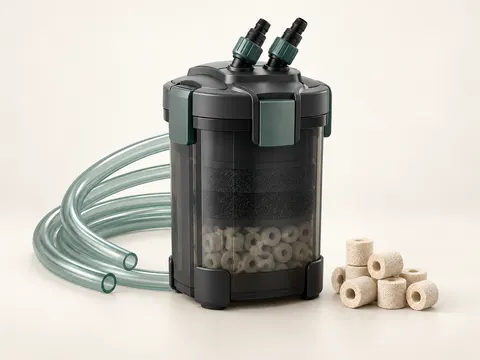
Both species do well with moderate (standard) water movement, so a standard filtration setup rated for the tank volume should suffice.
Why This Pairing Needs Extra Planning in Practice
This pairing usually fails when the tank is treated like a standard mixed community and the caution flags are ignored. Banded Cichlid and Twig Catfish (Farlowella) need extra room, more cover, and closer observation during the first few weeks so small aggression, feeding, or territory issues do not snowball into a long-term problem.
Supplies for Banded Cichlid & Twig Catfish (Farlowella)
We may earn from qualifying purchases



Suitable Tank Sizes
Standard aquarium sizes large enough for both Banded Cichlid and Twig Catfish (Farlowella).
75 Gallon Standard
90 Gallon Standard
125 Gallon Standard
150 Gallon High
180 Gallon Standard
350 Liter (120cm Deep)
Show 1 more tank size
Frequently Asked Questions
Can Banded Cichlid and Twig Catfish (Farlowella) live together?
They can coexist, but the pairing requires careful monitoring. Provide ample space (at least 250 litres), plenty of hiding spots, and watch for signs of stress or aggression.
What size tank do Banded Cichlid and Twig Catfish (Farlowella) need?
A minimum of 250 litres (tank length at least 120 cm) is recommended. This provides enough space for both species to establish their own areas and reduces the likelihood of territorial disputes.
What water temperature is best for Banded Cichlid and Twig Catfish (Farlowella) together?
Keep the aquarium between 23°C and 26°C. A target of around 24.5°C sits comfortably within both species' preferred ranges.
Are Banded Cichlid or Twig Catfish (Farlowella) aggressive?
Banded Cichlid is generally mild-mannered (4/10) and Twig Catfish (Farlowella) is peaceful (1/10). Their similar temperaments generally lead to a peaceful coexistence.
What pH do Banded Cichlid and Twig Catfish (Farlowella) need?
Both species overlap in the 6–7.2 pH range. Consistency is key — avoid sudden swings, and test regularly to stay within this window.
How do I manage Banded Cichlid's territorial behaviour?
Provide line-of-sight breaks using rocks, driftwood, and dense planting. A larger tank gives Banded Cichlid space to claim a territory without encroaching on the other fish's area. Adding décor that divides the tank into distinct zones works especially well.
Shared setup supplies
We may earn from qualifying purchases




Guidarium Editorial Desk
Reviewed against Guidarium care, stocking, and compatibility standards. Read the editorial policy.
- Last reviewed
- April 29, 2026
- Last updated
- April 29, 2026
- Issues or corrections?
- Contact the editorial team
Related Comparisons
Banded Cichlid & Aequidens Jenaro Herrera
·
Banded Cichlid & Altifrons Eartheater
·
Banded Cichlid & Bahia Red
·
Banded Cichlid & Barlow's Dwarf Cichlid (Apistogramma Maulbrüter)
·
Banded Cichlid & Blue Acara
·
Banded Cichlid & Chocolate Cichlid
·
Twig Catfish (Farlowella) & Dwarf Cory (Tailspot Cory)
·
Twig Catfish (Farlowella) & Dwarf Petricola
·
Twig Catfish (Farlowella) & Golden Oto
·
Twig Catfish (Farlowella) & Otocinclus
·
Twig Catfish (Farlowella) & Pygmy Corydoras
·
Twig Catfish (Farlowella) & Royal Farlowella Catfish
·